
AI Governance: The Complete Guide for SMBs (2026)
AI Governance: The Complete Guide for SMBs (2026)
By David Mosher, CEO, Rhindon Cyber | AI Governance & Compliance Expert | Former Microsoft, Bridgewater Associates and Raytheon
Quick Answer: AI governance is the framework of policies, processes, and controls that guide how an organization uses AI responsibly, safely, and in compliance with regulations. For small and medium-sized businesses (SMBs), it means knowing what AI tools your team is using, classifying their risk, setting usage rules, and documenting accountability — before a data breach or regulatory fine forces the issue.
Table of Contents
- What Is AI Governance?
- Why AI Governance Matters for SMBs in 2026
- The Shadow AI Problem
- The Major AI Governance Frameworks
- The EU AI Act: What SMBs Must Do
- The Five Pillars of Practical AI Governance
- Governance Operations: Who Decides, and How You Prove It
- Evidence That Holds Up Under Audit
- How to Build an AI Governance Program in 5 Steps
- AI Governance for MSPs: A High-Margin Opportunity
- How RAIC Automates AI Governance for SMBs
- References
What Is AI Governance?
AI governance is a framework of rules, practices, and policies that direct how an organization develops, procures, and uses artificial intelligence technologies (National Institute of Standards and Technology [NIST], 2023). It covers accountability (who is responsible when AI goes wrong), transparency (can decisions be explained), data privacy (what data feeds the AI), and compliance (which regulations apply).
For large enterprises, AI governance has matured into dedicated programs with C-suite ownership, legal review, and third-party audits. For SMBs, the picture is fundamentally different — and far more urgent than most owners realize. The governance problem at the SMB level is not about building AI systems from scratch. It is about the dozens of AI tools already running inside your business right now — many of them without anyone's knowledge or approval.
Think of AI governance not as a compliance checkbox, but as an operating discipline — the same discipline that led businesses to lock down their financial controls, their HR data, and their customer records. AI deserves the same rigor.
Why AI Governance Matters for SMBs in 2026
The scale of AI adoption in small and medium-sized businesses accelerated dramatically over the past two years, and the governance gap has widened just as fast.
- 58% of small businesses now use generative AI, up from 40% in 2024 and more than double the 2023 adoption rate of 23% (U.S. Chamber of Commerce Technology Engagement Center [C_TEC], 2025).
- Nearly 70% of SMBs remain in the experimental or early stages of AI maturity, meaning adoption is outpacing governance infrastructure by a wide margin (IDC & SAS, 2026).
- 81% of SMBs are not prepared or remain in the early stages of preparedness for AI-related threats (IDC, 2026).
- 63% of organizations lack any formal AI governance plan or are still developing one (IBM Security, 2025).
Those are not enterprise statistics. They describe the typical SMB in 2026: using AI at scale, without the policies or visibility to manage the risk.
The financial stakes are equally stark. The global average cost of a data breach was $4.44 million in 2025 (IBM Security, 2025). Breaches involving shadow AI — unmonitored AI tools — carried an average additional cost of $670,000 above the standard breach figure (IBM Security, 2025). Most SMBs do not survive a breach at that scale.
Beyond breaches, regulatory pressure is arriving fast. The EU AI Act (Regulation [EU] 2024/1689) enters full enforcement for most provisions on August 2, 2026, with no blanket SMB exemption (European Parliament & Council of the European Union, 2024). NIST AI RMF adoption is increasingly referenced by federal procurement and cybersecurity insurance underwriters as a baseline requirement (NIST, 2023).
The Shadow AI Problem
Shadow AI is the use of AI tools by employees without IT knowledge, approval, or oversight (IBM Security, 2025).
Shadow AI is the most immediate AI governance risk for SMBs. Employees did not wait for a corporate AI policy. They downloaded browser extensions, signed up for ChatGPT, Claude, and Gemini on personal accounts, and started feeding company data — client names, financial projections, legal contracts, HR records — into public AI models. This happens in every organization, at every size.
The numbers confirm it. As of 2025, 75% of workers report using AI on the job (IBM Security, 2025). Yet most of that usage is happening outside approved channels, outside the visibility of IT, and outside the reach of data security controls.
The risk profile of shadow AI is not theoretical:
- Data leakage: Employees entering confidential client data into consumer-grade AI tools that train on user inputs
- IP exposure: Business strategies, code, and unreleased product information fed into public models
- Compliance violations: Personal data of EU customers entered into AI systems without proper data processing agreements — a direct GDPR/EU AI Act liability
- Unvetted decisions: AI-generated output used in HR decisions, financial analysis, or customer communications without human review
The first step toward AI governance is shadow AI discovery — finding out what tools are already in use, who is using them, and what data is going in. RAIC discovers AI use four ways at once: browser extensions for Chrome and Firefox that see tool usage on managed devices, directory ingest that surfaces non-human identities and app consents granted in Microsoft 365, agentless vendor collectors that pull scheduled usage telemetry from Microsoft 365, ChatGPT and Claude, and session scoring that flags automated or agent-driven activity. The result is a real-time AI inventory before you write a single policy.
The Major AI Governance Frameworks
Several established frameworks provide structure for AI governance programs. SMBs do not need to implement all of them — but understanding which framework aligns with your regulatory environment helps you prioritize.
NIST AI Risk Management Framework (AI RMF 1.0)
Published by NIST on January 26, 2023, the AI RMF is the de facto U.S. standard for AI risk management (NIST, 2023). It is voluntary, but increasingly referenced in federal procurement, cybersecurity insurance requirements, and state AI legislation as the baseline for responsible AI use. The framework is built around four interconnected functions:
| Function | What It Means for Your SMB |
|---|---|
| GOVERN | Establish policies, assign accountability, define risk tolerance, train staff |
| MAP | Identify all AI systems in use, document their purpose and data inputs, classify risk |
| MEASURE | Evaluate performance, test for bias and drift, assess impact on stakeholders |
| MANAGE | Respond to identified risks — remediate, monitor, and improve over time |
These functions form a continuous cycle (NIST, 2023). For most SMBs, starting with GOVERN (documenting a policy) and MAP (inventorying AI tools) covers 80% of practical risk reduction.
ISO/IEC 42001:2023
ISO 42001 is the international standard for Artificial Intelligence Management Systems (AIMS), published by ISO/IEC in December 2023 (International Organization for Standardization [ISO], 2023). It defines formal requirements for establishing, implementing, maintaining, and continually improving an AI management system — the AI equivalent of ISO 27001 for information security. The standard addresses (ISO, 2023):
- Data management and protection — responsible, transparent handling of training and operational data
- AI security — safeguarding systems against external threats and insider misuse
- Control objectives — policies governing AI development, procurement, and deployment
- Continuous improvement — regular review and update of governance practices using the Plan-Do-Check-Act methodology
For SMBs pursuing contracts with government agencies, enterprise clients, or operating in regulated industries, ISO 42001 certification provides a credible, externally verifiable signal of AI governance maturity.
Your AI Framework Is Not Your Only Framework
AI governance does not live apart from the cyber and privacy obligations you already carry. The same AI system that needs an EU AI Act risk tier also sits inside your SOC 2 scope, touches HIPAA data, or falls under an examiner's cyber expectations. Running those as separate programs means answering the same question four times with four different answers.
RAIC maps ten frameworks against one unified controls register, so a single piece of evidence satisfies every framework it touches:
- AI-specific: ISO/IEC 42001, NIST AI RMF, EU AI Act
- Cyber and assurance: NIST CSF 2.0, SOC 2, CIS Controls v8.1
- Sector and regulated: HIPAA, SEC/FINRA
- Mapped references: Treasury FS AI RMF and C2M2, crosswalked to the frameworks above
NIST AI RMF vs. ISO 42001: Which Is Right for Your SMB?
| Criterion | NIST AI RMF | ISO 42001 |
|---|---|---|
| Origin | U.S. Government (NIST) | International Standards Organization |
| Format | Voluntary guidance framework | Certifiable management system standard |
| Best for | U.S.-focused businesses, federal contractors | Global operations, client-facing certification |
| Implementation complexity | Moderate | Higher (formal AIMS required) |
| Certification available | No | Yes (third-party audit) |
| Maps to RAIC assessments | ✓ | ✓ |
For most SMBs, starting with NIST AI RMF alignment and evolving toward ISO 42001 as the business scales is the practical path forward.
The EU AI Act: What SMBs Must Do
The EU AI Act (Regulation [EU] 2024/1689) was published in the Official Journal of the European Union on July 12, 2024, entered into force on August 1, 2024, and will reach full enforcement for most provisions on August 2, 2026 (European Parliament & Council of the European Union, 2024). NOTE: There have been recent changes to some of the regulations - so please validate all going live dates. If your business has EU customers, EU employees, or EU operations — and uses any AI tool to serve them — you have compliance obligations under the Act, regardless of where your business is headquartered.
Critical fact for SMBs: There is no blanket exemption for small businesses. The EU AI Act applies to providers and deployers of AI systems whose outputs are intended to be used in the Union — including organizations established in third countries (European Parliament & Council of the European Union, 2024, Article 2).
The Four Risk Tiers
| Risk Level | Examples | Obligation |
|---|---|---|
| Unacceptable (Prohibited) | Social scoring, real-time biometric surveillance in public spaces | Prohibited since February 2, 2025 |
| High-Risk | AI in HR decisions, credit scoring, safety-critical systems | Conformity assessment, human oversight, audit logs, FRIA |
| Limited Risk | Chatbots, AI-generated content, voice assistants | Transparency disclosures required (Article 50) |
| Minimal Risk | Spam filters, AI-powered search | No specific obligations |
What Most SMBs Must Do Right Now
- Article 4 (AI Literacy) — required since February 2025. Document staff training on AI systems in use (European Parliament & Council of the European Union, 2024).
- Article 50 (Transparency) — if deploying a chatbot or AI-generated content publicly, users must be informed they are interacting with AI (European Parliament & Council of the European Union, 2024).
- AI Inventory — document every AI system in use, its purpose, and its risk classification.
- High-risk obligations — if using AI in HR, credit, or safety-critical decisions affecting EU citizens, a Fundamental Rights Impact Assessment (FRIA), human oversight documentation, and decision logs retained for a minimum of six months are required (European Parliament & Council of the European Union, 2024, Article 26).
Penalties are real. Violations of high-risk AI obligations can reach €15 million or 3% of global annual turnover; using prohibited AI practices can reach €35 million or 7% of global turnover (European Parliament & Council of the European Union, 2024, Article 99).
The Five Pillars of Practical AI Governance
Pillar 1: Approved Tools (AI Inventory)
Establish a managed list of AI tools that the business has assessed, contracted on a business plan, and made available to staff. Everything outside that list is shadow AI until reviewed. A healthy AI inventory documents every AI tool in use, who uses it, what data it accesses, whether the vendor prohibits training on customer data, and the tool's risk classification (IBM Security, 2025; NIST, 2023).
Pillar 2: Data Classification and Use Rules
Staff need to know, in plain language, what data is permitted in which AI tool. A practical data classification framework:
- Public information — approved for any tool
- Internal information — approved only for enterprise-licensed tools with data protection agreements
- Confidential information — restricted to approved tools with verified zero-training provisions
- Regulated data (PII, PHI, financial records) — never permitted in third-party AI tools without explicit legal basis and a vendor Data Processing Agreement (DPA)
Pillar 3: Identity and Access Management
AI accounts should be provisioned through the business identity provider. When an employee leaves, AI tool access is revoked and usage history is retained or deleted according to your data retention policy. This pillar extends to AI agents — non-human identities that access systems and process data at scale (IBM Security, 2025).
Pillar 4: Spend Visibility and Token Control
AI spend needs to be visible to finance and team leaders. Without visibility, costs accumulate across unmanaged subscriptions and personal cards until someone discovers a liability no one owns. RAIC's cost tracking dashboard aggregates AI spend across approved tools, identifies unauthorized subscriptions, and provides a consolidated view of total AI investment.
Pillar 5: Logging and Review
For sensitive use cases — HR decisions, financial analysis, legal research, customer-facing communications — prompts and responses should be logged for potential review. The EU AI Act requires audit logs for high-risk AI systems for a minimum of six months (European Parliament & Council of the European Union, 2024, Article 12). Even for lower-risk tools, 90-day logging provides meaningful protection in the event of a breach investigation or customer dispute.
Governance Operations: Who Decides, and How You Prove It
Most SMB governance programs fail in the same place. The policy exists. The inventory exists. But the approvals live in email, the exceptions live in someone's head, and when an auditor asks who authorized a high-risk AI system to go live — and under what authority — nobody can answer.
Decision rights are the missing half of AI governance. Every major framework asks for them. ISO 42001 requires defined roles and responsibilities. NIST AI RMF puts accountability at the centre of the GOVERN function. The EU AI Act requires documented human oversight for high-risk systems. None of that is satisfied by a policy document alone.
A working governance operation has six moving parts:
- A governance council with real meetings: A standing body with an agenda, attendance, and minutes — not an ad-hoc email thread.
- A decision register: Every approval and every refusal recorded with the reasoning, the date, and the person who made the call. Refusals matter as much as approvals; they prove the process has teeth.
- An action register: What was agreed, who owns it, and when it is due.
- Exceptions and waivers with expiry dates: A documented, time-bounded exception is governance. An undocumented one is a finding.
- An escalation ladder: A defined path for decisions that exceed someone's authority, so work does not stall and nobody quietly approves above their level.
- An authority matrix: A written statement of who may approve what. Risk-acceptance authority separates by residual risk level, delegation is bounded, and separation of duties prevents one person from both requesting and approving.
What about emergencies? Real businesses face decisions at 2 a.m. Time-bounded emergency authority — break-glass — lets a named person act outside the normal route, with a countdown on the grant and a mandatory retrospective review afterwards. That is defensible. An undocumented exception made under pressure is not.
Evidence That Holds Up Under Audit
Governance you cannot prove is governance you do not have. Screenshots and spreadsheets fail the moment an auditor asks whether the record could have been edited after the fact.
- A chained evidence ledger: Each record is fingerprinted with SHA-256 and linked to the one before it, so any later alteration breaks the chain and is detectable.
- A daily seal: Records are sealed nightly into a day root, and inclusion proofs let you show a single record belongs to a sealed day without exposing anything else.
- Signed audit packs: Exportable bundles signed with ECDSA P-256 that an auditor can verify offline, with an independent verifier available so they do not have to take our word for it.
- Continuity certificates: A portable statement that the record has been kept continuously over a period.
- Anonymous peer benchmarks: See how your governance posture compares with similar organizations by industry, without exposing your data or anyone else’s.
An honest boundary: no regulator requires hash-chained evidence, and no framework awards credit for it. What it does is remove the argument about whether the record was changed after the fact, so the conversation stays on substance.
How to Build an AI Governance Program in 5 Steps
Step 1: Run a Shadow AI Audit (Week 1)
Before writing a single policy, discover what AI tools are already running in your organization. Most businesses are surprised by what they find (IBM Security, 2025). Send an anonymous survey asking staff which AI tools they use to save time; review credit card statements for AI subscriptions; ask IT to pull DNS logs showing AI endpoint traffic; inventory browser extensions across managed devices.
RAIC automates this audit through browser extensions, directory ingest and agentless vendor collectors, delivering a full shadow AI inventory in under 24 hours — without requiring employees to self-report.
Step 2: Assign Ownership and Form an AI Oversight Committee (Week 1–2)
Form a cross-functional AI Oversight Committee — even if it is just three people — with representation from IT, legal/compliance, and a business unit leader. This committee maintains the approved tools list, reviews new AI tool requests, updates the AI governance policy as regulations evolve, and handles AI-related incidents (NIST, 2023).
Write down who may approve what before the first request arrives. Set risk-acceptance authority by residual risk level, name a deputy for each approver, and agree the escalation path for anything above the line. RAIC generates approval routes for use cases, AI systems, controls and policy versions directly from that authority matrix, and records every decision and refusal as it happens.
Step 3: Write and Distribute an AI Governance Policy (Week 2–3)
A minimum-viable AI governance policy for SMBs includes:
- Approved tools whitelist — which AI tools are sanctioned, for which purposes, and by whom
- Prohibited uses — what data must never enter any AI tool (PII, PHI, trade secrets, client data under NDA)
- Data classification rules — public / internal / confidential / regulated tiers with clear examples
- Human review requirements — all outward-facing AI-generated content requires human sign-off
- New tool approval process — how employees request approval for an unapproved tool
- Training and acknowledgment — staff must sign policy confirmation; EU AI Act Article 4 requires documented AI literacy training (European Parliament & Council of the European Union, 2024)
- Incident reporting — how employees report suspected AI-related data exposures
Step 4: Classify Your AI Systems by Risk (Week 3–4)
Map every AI tool in your inventory against the NIST AI RMF MAP function or the EU AI Act's four-tier risk classification (NIST, 2023; European Parliament & Council of the European Union, 2024). For each tool, document business purpose, data inputs, decision impact, risk level, and required oversight. High-risk tools require a Fundamental Rights Impact Assessment before deployment under the EU AI Act (European Parliament & Council of the European Union, 2024, Article 26).
Step 5: Monitor, Measure, and Update (Ongoing)
AI governance is not a document filed and forgotten. Maintain a continuous monitoring cycle:
- Quarterly AI inventory review — check for new AI tools entering the organization
- Annual policy review — update for regulatory changes, new AI capabilities, and lessons from incidents
- Ongoing shadow AI monitoring — RAIC's agent provides continuous detection of new AI tool adoption
- Metrics tracking — number of unapproved AI tool blocks, monthly AI spend, staff training completion rates, incidents reported
AI Governance for MSPs: A High-Margin Opportunity
For Managed Service Providers, AI governance is not just a client obligation — it is a high-margin service line. The SMB AI governance gap creates a structural opportunity: SMB clients are adopting AI at scale without the internal capacity to govern it (IDC & SAS, 2026; IDC, 2026). MSPs that build AI governance into their service stack are positioned to expand recurring revenue, deepen client relationships, and differentiate from commodity IT providers.
A packaged AI governance service for MSP clients can include:
- Discovery and inventory — shadow AI audit across client environments, delivered as a one-time assessment and then as ongoing monitoring
- Risk classification — categorizing client AI systems against NIST AI RMF and EU AI Act risk tiers (NIST, 2023; European Parliament & Council of the European Union, 2024)
- Data sensitivity and permissions review — identifying where client PII, IP, and financial data is being fed into unvetted AI tools
- Policy development — customized AI acceptable use policies (AUP) for each client's regulatory context
- Strategic roadmap and compliance documentation — a written AI governance program that clients can present to insurers, enterprise customers, and regulators
RAIC’s white-label Partner Portal lets MSPs run the same governance operating model across every client tenant from one console: per-client dashboards, guided onboarding, consolidated reporting, partner-led client licensing, packaged Shadow AI assessment packs to sell as a fixed-fee engagement, free partner seats, and volume discounts that scale with licence count. Full details are on the MSP page.
How RAIC Automates AI Governance for SMBs
RAIC (AI Risk & Integrity Cloud) by Rhindon Cyber is an AI governance, compliance, and shadow AI detection platform built specifically for SMBs and the MSPs that serve them.
Shadow AI Discovery — Chrome and Firefox extensions, directory ingest for non-human identities, agentless vendor collectors for Microsoft 365, ChatGPT and Claude, and automated session scoring combine into one continuous inventory of AI use across the business.
Unified Controls Register — One control set mapped to ten frameworks: ISO/IEC 42001, EU AI Act, NIST AI RMF, NIST CSF 2.0, SOC 2, CIS Controls v8.1, HIPAA, SEC/FINRA, plus Treasury FS AI RMF and C2M2 as mapped references. Evidence entered once counts everywhere it applies.
AI System and Use Case Registry — Every AI tool and every proposed use case is cataloged with purpose, data classification, oversight requirements, approval status, and both inherent and residual risk — so you can show the risk before controls and the risk that remains.
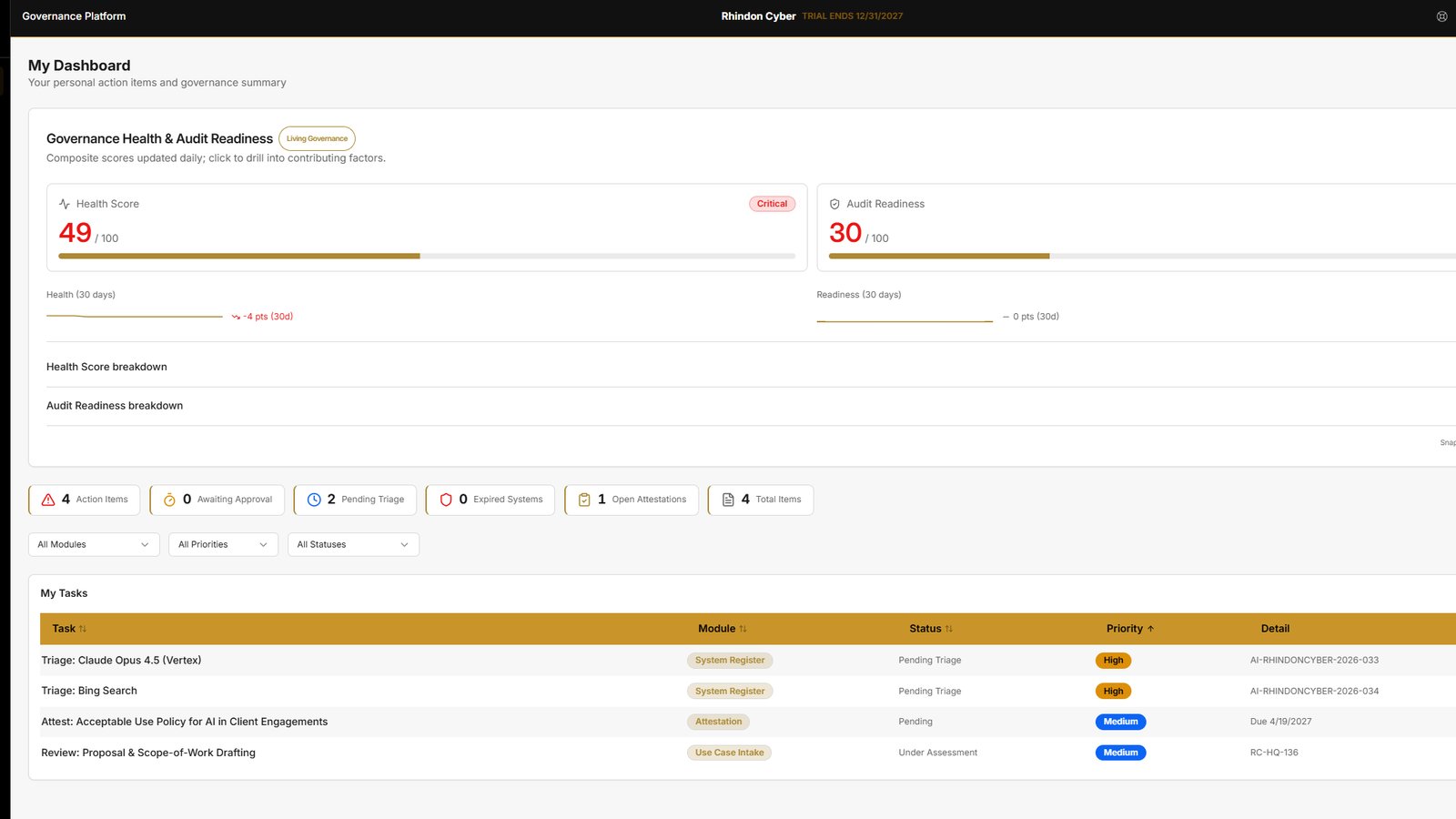
Governance Operations & Decision Rights — Council and meetings, decision and action registers, exceptions and waivers with expiry dates, an escalation ladder, a governance calendar, and an operator cockpit that ranks what needs attention and explains the ranking. A configurable authority matrix generates the approval routes, separates risk-acceptance authority by residual level, and supports time-bounded break-glass with retrospective review.
Aslan AI Assistant — A policy-aware assistant that drafts from 10 governance policy templates, answers questions against your own policies and controls, and keeps generated documents tied to the framework clauses they satisfy.
AI Data Governance — In-line detection of sensitive data heading into AI tools, using named entity recognition, so regulated data is caught before it leaves the business rather than discovered afterwards.
Automation Agents — Four agents that handle routine governance work with per-agent autonomy settings and a single approval inbox, so nothing acts on your behalf without the oversight you configured.
Verifiable Evidence Integrity — A chained SHA-256 ledger, a nightly seal with inclusion proofs, signed audit packs an auditor can verify offline, continuity certificates, and an independent second verifier.
Maturity Model and Peer Benchmarks — Governance and cyber maturity scoring with tiering, plus anonymous benchmarks against similar organizations by industry.
Reports Catalog — Pre-built exports in DOCX, CSV and PDF, including the Governance State & Continuity Pack and the governance registers, ready for boards, insurers, auditors and enterprise due diligence.
Public API and MCP Server — A public REST API and a first-party MCP server so your AI assistants and existing tooling can read and update governance records directly.
MSP Partner Portal — White-label multi-tenant delivery with per-client dashboards, guided onboarding, partner-led client licensing, free partner seats and volume discounts.
References
European Parliament & Council of the European Union. (2024, July 12). Regulation (EU) 2024/1689 of the European Parliament and of the Council of 13 June 2024 laying down harmonised rules on artificial intelligence (Artificial Intelligence Act). Official Journal of the European Union, L 2024/1689. eur-lex.europa.eu/eli/reg/2024/1689/oj
IBM Security. (2025). Cost of a data breach report 2025: The AI oversight gap. IBM Corporation. ibm.com/reports/data-breach
IDC & SAS. (2026, May 14). AI for SMBs: Closing the readiness-reality gap [Press release]. SAS Institute. sas.com/en_us/news/press-releases/2026/april/majority-of-smbs-remain-in-early-stages-of-ai-maturity--study-sa.html
IDC. (2026, May). SMBs in the age of AI: Navigating cyber complexity and building resilience (IDC InfoBrief, commissioned by Sage). Sage Group. sage.com/en-us/news/press-releases/2026/05/cybersecurity-climbs-the-smb-agenda-as-ai-pressure-exposes-resilience-gap
International Organization for Standardization. (2023, December). ISO/IEC 42001:2023 — Information technology — Artificial intelligence — Management system. iso.org/standard/42001
National Institute of Standards and Technology. (2023, January 26). Artificial intelligence risk management framework (AI RMF 1.0) (NIST AI 100-1). U.S. Department of Commerce. doi.org/10.6028/NIST.AI.100-1
U.S. Chamber of Commerce Technology Engagement Center. (2025, August 17). Empowering small business: The impact of technology on U.S. small business (4th ed.). U.S. Chamber of Commerce. uschamber.com/assets/documents/Empowering-Small-Business-Report-2025.pdf
This article was written by David Mosher, CEO of Rhindon Cyber and publisher of the Pragmatic Cybersecurity newsletter. Rhindon Cyber builds AI governance and risk management tools for SMBs and managed service providers. Start a 14-day free trial at raic.rhindoncyber.com/pricing.
FAQ
What is AI governance?
AI governance is the framework of policies, processes, and controls that guide how an organization develops, procures, and uses artificial intelligence responsibly and in compliance with applicable regulations. It covers accountability, transparency, data privacy, and risk management across all AI tools and systems in use (NIST, 2023).
Why do SMBs need AI governance?
AI adoption in SMBs has accelerated rapidly, with 58% of small businesses now using generative AI (C_TEC, 2025). Without governance, that adoption creates data exposure risk, regulatory liability under the EU AI Act and U.S. state laws, and financial risk — shadow AI breaches add $670,000 above average breach costs (IBM Security, 2025).
What is shadow AI?
Shadow AI refers to AI tools used by employees without IT knowledge, approval, or oversight (IBM Security, 2025). It includes browser extensions, consumer AI subscriptions, and embedded AI features in SaaS tools that were never formally reviewed. Shadow AI is the most immediate AI governance risk for most SMBs.
What is the NIST AI RMF?
The NIST Artificial Intelligence Risk Management Framework (AI RMF 1.0), published January 26, 2023, is a voluntary U.S. government framework for managing AI risk (NIST, 2023). It organizes risk management into four functions: Govern, Map, Measure, and Manage. The official DOI is https://doi.org/10.6028/NIST.AI.100-1.
Does the EU AI Act apply to my SMB?
If your business has EU customers, EU employees, or EU operations, and uses any AI tool to serve them, obligations apply under the EU AI Act regardless of where your business is based (European Parliament & Council of the European Union, 2024, Article 2). Full enforcement for most provisions began August 2, 2026. There is no blanket SMB exemption.
How long does it take to implement AI governance?
A working governance foundation — shadow AI audit, approved tools policy, risk classification, and oversight documentation — can be implemented in 30 to 60 days with the right tooling. RAIC automates the most time-intensive components, reducing implementation time significantly.
What is ISO 42001?
ISO/IEC 42001:2023 is the international standard for Artificial Intelligence Management Systems (AIMS), published December 2023 (ISO, 2023). It specifies requirements for establishing, implementing, maintaining, and improving an AI management system using the Plan-Do-Check-Act methodology. Unlike NIST AI RMF, ISO 42001 is certifiable via third-party audit.
What is an AI System Registry?
An AI System Registry is a documented record of every AI system in use — including purpose, data inputs, risk classification, oversight requirements, and approval status. It is required by both ISO 42001 and the EU AI Act (ISO, 2023; European Parliament & Council of the European Union, 2024).
How do MSPs offer AI governance as a service?
MSPs can package AI governance as a recurring managed service combining shadow AI discovery, risk assessment, policy management, and compliance documentation. The SMB AI governance gap — with 70% of SMBs in early AI maturity stages (IDC & SAS, 2026) — provides a large addressable market for this service.
What does RAIC do?
RAIC (AI Risk & Integrity Cloud) by Rhindon Cyber automates shadow AI discovery via a browser extension agent, maps AI posture against NIST AI RMF and ISO 42001, generates compliance documentation, and provides MSPs with a multi-tenant portal for delivering AI governance as a managed service. Request a free assessment at raic.rhindoncyber.com. ***
Bring AI governance into one platform
Start a free trial of RAIC and operationalize the practices in this article.
Start trial