
POLICY IS NOT A PROGRAM.
GOVERNANCE IS WHAT YOU CAN PROVE.
AI Governance is the operating system for responsible AI — the policies, controls, accountability, and evidence that turn good intentions into defensible decisions. RAIC gives you the system of record your board, your regulators, and your auditors are about to ask for.
The operating system for responsible AI.
AI Governance is the discipline of deciding — clearly, repeatably, and with evidence — which AI you build, which AI you buy, which AI you allow, and which AI you stop. It spans policy, risk, controls, accountability, and proof. Done well, it lets the business move faster with AI because the guardrails are real instead of imagined.
Done poorly, it's a 40-page PDF that nobody reads, a spreadsheet that nobody updates, and a quarterly steering committee that approves whatever already shipped. That model collapses the first time a regulator, an auditor, or a board member asks "show me."
In 2026, AI is on the board agenda. Every framework RAIC maps — ISO 42001, NIST AI RMF, the EU AI Act, SEC/FINRA — assumes you can produce a governed inventory of AI systems with owners, risk scores, and evidence. Governance is no longer optional, and a policy document is no longer enough.
Six steps, in the order that works.
- 1
Inventory the AI you already use: List sanctioned AI systems and use cases, then find the unsanctioned ones with Shadow AI discovery.
- 2
Write a policy people can follow: Start with an AI acceptable use policy: approved tools, data rules and human review of output.
- 3
Assign decision rights: Decide who may approve, reject, escalate or accept risk for each AI decision, and under what limits.
- 4
Score risk before and after controls: Rate each use case for inherent risk (before controls) and residual risk (after controls) so treatment is visible.
- 5
Map controls to your frameworks: Map one set of controls to ISO 42001, NIST AI RMF or the EU AI Act so one piece of evidence serves several obligations.
- 6
Review on a schedule and keep evidence: Re-assess on a fixed cycle and record every approval, exception and review so you can show it later.
AI GOVERNANCE FOR SMALL BUSINESSES AND MSPS
You don't need a governance department to start. Small businesses can run these six steps with a policy owner and a monthly review, and managed service providers can deliver them as a recurring service across clients. Start with these guides:
From slide deck to system of record.
Policy that actually binds
Acceptable-use, model-use, and data-handling policies versioned in one place — with attestations linked to the people, systems, and use cases they govern.
Use case intake & dual-risk scoring
Every AI use case enters through a structured intake and is scored against your risk framework with two L×I triples — inherent (before controls) and residual (after controls). Same model applies to AI Systems. Heatmap toggles and register exports show both, plus the delta.
Control mapping across frameworks
One set of controls mapped once to ISO 42001, NIST AI RMF, the EU AI Act, and SEC/FINRA — so a single piece of evidence satisfies multiple obligations.
Evidence an auditor can verify
Attestations, impact assessments, supplier reviews, and incident records captured as fingerprinted, hash-chained evidence an auditor can verify — not screenshots pasted into a slide deck the night before.
Inventory. Workflow. Roles. Posture.
Governance lives where the work happens — not in a parallel document that has to be updated by hand.
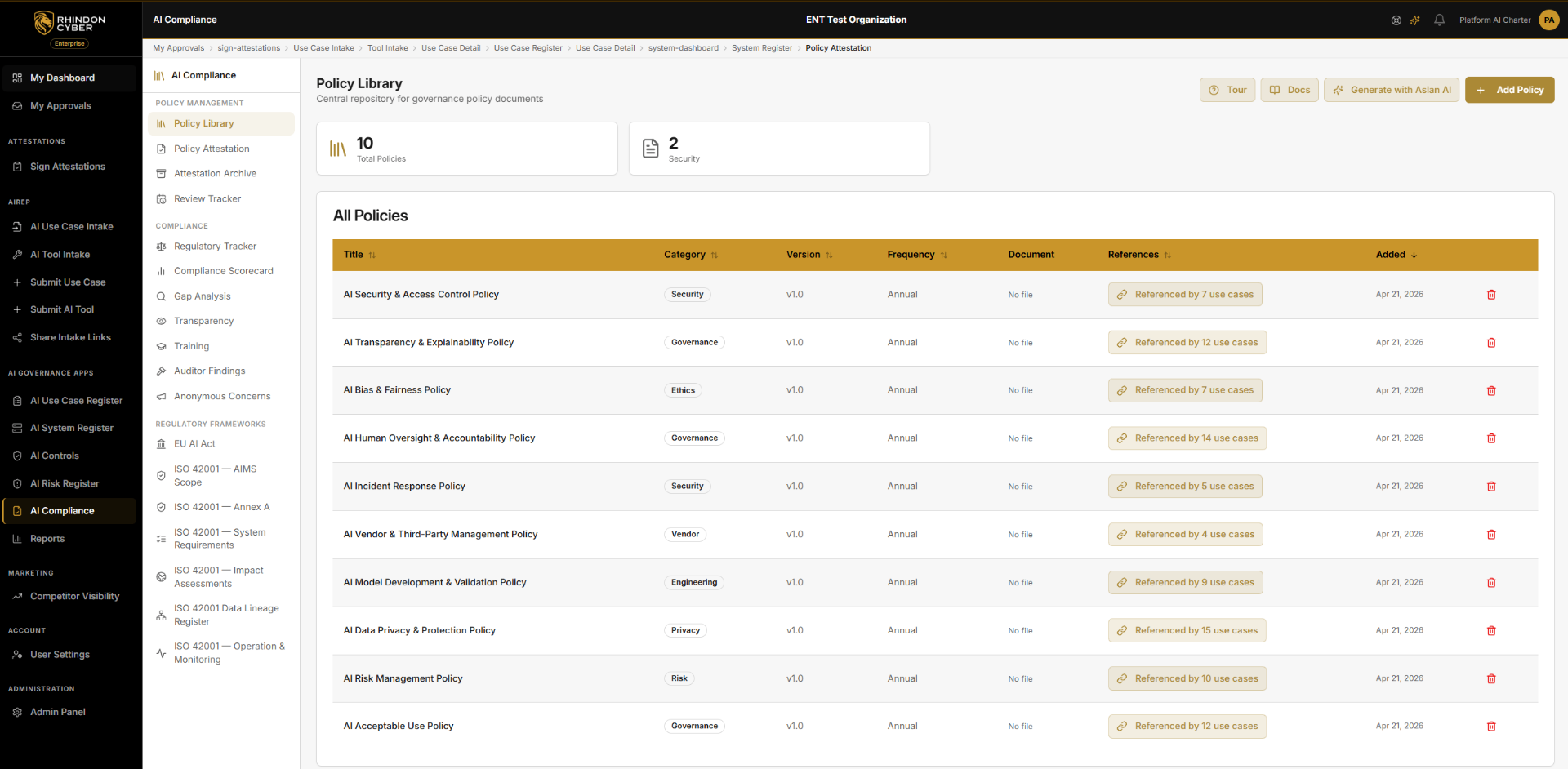
AI system & use case registry
A single inventory of every sanctioned AI system, model, and use case — with owners, data classifications, vendors, and lifecycle state.
Workflows for the whole lifecycle
Intake, review, approval, change management, periodic re-assessment, and decommissioning — each step owned, timestamped, and evidenced.
Roles that match how you actually work
OrgAdmin, Compliance, Risk, Engineering, and Business Owner roles — with separation of duties enforced in the platform, not in a tribal-knowledge spreadsheet.
Posture you can put on a board slide
Coverage, maturity, heatmaps, and trends through the PowerGRYD reporting suite — so leadership sees governance as a metric, not a memo.
Governance is decision rights you can prove
A governance program is only as strong as its answer to one question: who was allowed to decide this? RAIC turns that answer into working software.
- Authority matrix: configure who may approve what, by role, risk level, and asset type — then let approval routes for use cases, AI systems, controls, and policy versions be generated from it.
- Risk acceptance by residual level: accepting leftover risk is its own authority, held by the person your matrix names for that level — not by whoever happened to be in the meeting.
- Councils and registers: meetings, decisions, actions, exceptions, and escalations are recorded as you run the program, so your governance history is evidence rather than recollection.
- Provable refusals: the requests you turned down are recorded with the same rigor as the ones you approved — increasingly the first thing an examiner asks for.
Stand up. Intake. Operate. Prove.
Stand up
Import your policies, map your frameworks, and seed your AI system registry. RAIC ships with opinionated defaults so you don't start from a blank page.
Intake
Route every new AI use case through a structured intake. Risk-score it. Assign reviewers. Track it from idea to production with full history.
Operate
Run impact assessments, supplier reviews, and attestations on a schedule. Capture incidents and concerns. Re-assess when systems or data change.
Prove
Export audit-ready evidence packages — mapped to ISO 42001, NIST AI RMF, the EU AI Act, or SEC/FINRA — in minutes, not weeks.
A program your board can see.
- Replace policy PDFs with a living system of record
- Give every AI use case an owner, a risk score, and a decision trail
- Map one control once and satisfy four frameworks
- Hand auditors evidence packages instead of explanations
- Show the board a governance posture metric, not a memo
- Cut review cycles from weeks to days without cutting rigor
AI governance, answered.
- How do you build an AI governance program?
- Inventory the AI you already use, including Shadow AI; write an AI acceptable use policy; assign decision rights; score inherent and residual risk; map controls to frameworks such as ISO 42001, NIST AI RMF or the EU AI Act; and review on a schedule while keeping evidence of every decision.
- Can a small business do AI governance?
- Yes. A small business can run AI governance with one policy owner, an approved-tools list, a simple decision-rights matrix and a monthly review. Managed service providers can also deliver it as a service.
- What is AI governance?
- AI governance is the set of policies, processes, controls, and accountability structures that an organization uses to decide which AI systems it builds, buys, allows, and retires — and to prove those decisions to boards, regulators, and auditors. It spans policy, risk, controls, accountability, and evidence across the full AI lifecycle.
- How is AI governance different from AI risk management?
- AI governance is the program — the operating model, roles, policies, and decision rights. AI risk management is one function inside that program: identifying, scoring, treating, and monitoring risks for individual AI systems and use cases. You need governance to give risk management authority, scope, and a place to file evidence.
- Why do we need AI governance now?
- Boards, regulators, and customers now expect a defensible inventory of AI systems with owners, risk scores, and evidence. ISO/IEC 42001, the EU AI Act, NIST AI RMF, and SEC/FINRA all assume a governed program exists. A 40-page policy PDF and a quarterly steering committee no longer satisfy the question 'show me.'
- Which frameworks does AI governance need to cover?
- Most organizations map to ISO/IEC 42001 (the AI management system standard), NIST AI RMF (GOVERN, MAP, MEASURE, MANAGE), the EU AI Act (provider, deployer, importer, distributor obligations), and sector rules such as SEC/FINRA. Cyber frameworks — SOC 2 (61 Trust Services Criteria), NIST CSF 2.0, and CIS Controls v8.1 — increasingly sit alongside AI governance because customer and auditor questionnaires now ask for both. A mature program maps one control once and satisfies multiple frameworks from the same evidence.
- What are the four pillars of an AI governance program?
- Policy that actually binds (acceptable-use, model-use, data-handling), use case intake and risk scoring, control mapping across frameworks, and audit-grade evidence (attestations, impact assessments, supplier reviews, incident records). Together they turn governance from a slide deck into a system of record.
- Who owns AI governance inside an organization?
- AI governance is cross-functional. Typical owners include a Chief AI Officer or AI governance lead, with shared accountability across Compliance, Risk, Security, Legal, Privacy, Engineering, and the Business Owner for each use case. RAIC enforces this with OrgAdmin, Compliance, Risk, Engineering, and Business Owner roles plus separation of duties.
- How does RAIC operationalize AI governance?
- RAIC replaces spreadsheets and policy PDFs with a structured system of record: a unified AI + Cyber systems registry, a use case register with structured intake and risk scoring, a Controls Register with a multi-link framework adapter that maps one control to ISO 42001, NIST AI RMF, the EU AI Act, NIST CSF 2.0, SOC 2, CIS v8.1, and SEC/FINRA at once, attestation and supplier workflows, the Aslan AI Copilot for read-only drafting assistance, and auditor-grade evidence exports — all surfaced as GMI, CGMI, and combined Total Governance Posture (TGP) on the board-ready Maturity Dashboard. See /maturity-model for a full overview of the scoring model.
- Who is allowed to accept AI risk?
- Whoever your authority matrix names — and nobody else. RAIC separates risk-acceptance authority by residual risk level, so a low residual risk can stop with the system owner while a high residual risk routes to the executive or governance council you named for it. Because approval routes are generated from the matrix, the right approver is selected by the rule rather than remembered by a person, and the acceptance is recorded with the authority behind it.
- What happens when a decision has to be made outside normal hours?
- Emergency break-glass authority grants a named person temporary powers on a visible countdown. The grant is time-bounded, expires on its own, and triggers a retrospective review once it closes — so an urgent Saturday decision stays defensible on Monday instead of becoming an approval nobody can explain.
- How long does it take to stand up AI governance with RAIC?
- Most teams stand up an initial program in weeks rather than quarters. RAIC ships with opinionated defaults — 10 policy templates, mappings across ten frameworks, intake forms, and a seeded control library — so you start from a working baseline instead of a blank spreadsheet.
From the Resources library
Frameworks, operating models, and field playbooks for governing AI responsibly.
STOP WRITING POLICY. START PROVING IT.
Spin up RAIC in your tenant and see Shadow AI in your environment within a day.
Self-service online demo — explore RAIC's modules and workflows on your own time, no scheduling required.
MSP, reseller, and audit-partner programs. Email the partner desk.