
AI Governance Software for MSPs: What to Look For (2026 Buyer's Guide)
AI Governance Software for MSPs: What to Look For (2026 Buyer's Guide)
By David Mosher, CEO, Rhindon Cyber | AI Governance & Compliance Expert | Former Microsoft, Bridgewater Associates, Raytheon
Quick Answer: AI governance software for MSPs must do three things enterprise-grade tools cannot:
- Operate across multiple client tenants simultaneously.
- Deliver governance outputs that a non-technical SMB client can act on without hiring a compliance team.
- Map findings to key regulatory frameworks—NIST AI RMF, ISO 42001, EU AI Act. Clients will be asked about these frameworks in vendor questionnaires, cyber insurance applications, and contract due diligence.
The market has a growing number of platforms built for enterprises with dedicated AI governance staff. Far fewer are designed for the MSP delivery model. This guide identifies the eight capability criteria that separate genuinely MSP-ready AI governance tools from repurposed enterprise platforms. It also explains the business case for adding AI governance as a managed service in 2026.
Table of Contents
- Why MSPs Are Now in the AI Governance Business
- The Academic Foundation: What Organizational AI Governance Actually Requires
- The Business Case: Revenue and Margin in AI Governance Services
- The Eight Criteria for MSP-Ready AI Governance Software
- The Multi-Tenant Imperative: Why Single-Tenant Tools Fail MSPs
- Framework Alignment: NIST AI RMF, ISO 42001, and EU AI Act in One Platform
- Shadow AI Detection as a Core MSP Service
- The Audit Trail and Reporting Engine: What Clients and Regulators Need to See
- Evaluation Checklist: 25 Questions to Ask Any AI Governance Vendor
- How RAIC Is Built for the MSP Delivery Model
- References
Why MSPs Are Now in the AI Governance Business
The managed service provider (MSP) channel has navigated three transformational waves in its history: the shift to managed services from break-fix, the migration to cloud infrastructure management, and the expansion into managed cybersecurity.
A fourth wave is arriving: managed AI governance. The difference this time is that the market need has appeared before most MSPs have built the capability to address it. This creates a window of competitive advantage for early movers.
Mäntymäki, Minkkinen, Birkstedt, and Viljanen (2022), in a foundational paper in AI and Ethics (Springer), define organizational AI governance as "a system of rules, practices, processes, and technological tools that are employed to ensure an organization's use of AI technologies aligns with the organization's strategies, objectives, and values; fulfils legal requirements; and meets principles of ethical AI followed by the organization." This definition—rules, practices, processes, and technological tools—embeds software as a structural component of governance, not an optional enhancement.
For most SMB clients, the MSP is the only realistic source of both the expertise and the tools required to build that system.
The AvePoint and Omdia (2026) research report, "The Road to AI Readiness: Unlocking the MSP AI Opportunity Through Governance," surveyed MSPs globally. It found that 51% identified data governance and compliance challenges as the biggest barrier to their clients' AI adoption, ahead of cost, technical complexity, and skills gaps.
In the same study, 49% of MSPs said they prefer a fully integrated governance platform. Another 91% said combining governance and data protection capabilities delivers stronger outcomes than deploying them separately. Governance is no longer a secondary service line—it is the primary gating factor determining whether MSP clients can adopt AI at all.
The Academic Foundation: What Organizational AI Governance Actually Requires
Understanding what AI governance software needs to do requires understanding what organizational AI governance requires—not as a product marketing description, but as an evidence-based organizational capability.
The Tripartite Governance Framework (Papagiannidis, Mikalef & Conboy, 2024)
Papagiannidis, Mikalef, and Conboy (2024), in a systematic review and conceptual framework published in the Journal of Strategic Information Systems (Elsevier, ABDC-A*), synthesize 48 empirical studies on responsible AI governance. They identify eight governance themes: privacy, accountability, safety and security, transparency and explainability, fairness and non-discrimination, human control, sustainability, and contestability.
The authors develop a tripartite framework of governance practices:
- Structural—policies, roles, formal mechanisms
- Relational—stakeholder processes, communication, culture
- Procedural—operational workflows, audit, continuous improvement
The implications for AI governance software evaluation are direct. A platform that addresses only structural governance—policy documentation and compliance checklists—satisfies the visible but least difficult requirement.
The governance failures that lead to regulatory penalties, operational harm, and reputational damage typically occur in the relational and procedural dimensions. These include failures of stakeholder impact assessment, disclosure mechanisms, audit trails, monitoring, and incident response. MSPs evaluating AI governance platforms should assess coverage across all three practice domains, not only the structural layer that generates the most visible documentation.
The Ethics-Based Auditing Capability Gap (Laine, Minkkinen & Mäntymäki, 2024)
Laine, Minkkinen, and Mäntymäki (2024), in a systematic literature review in Information & Management (Elsevier, Vol. 61, Issue 5, ABDC-A*), synthesize the AI auditing literature. They identify three types of knowledge that AI auditing must produce for stakeholders:
- Guidance (what to do)
- Methods and tools (how to do it)
- Awareness and empowerment (understanding what is happening and why it matters)
The review finds a persistent gap between the volume of AI ethics frameworks published and the availability of practical, operational tools that make those frameworks actionable for non-specialist stakeholders. This is precisely the situation SMB clients face.
For MSPs, this gap is the value proposition. SMB clients cannot staff AI ethics or AI governance expertise internally. They need a partner who provides both the guidance and the tools simultaneously. An MSP equipped with the right AI governance platform can deliver all three auditing knowledge types to clients—turning a compliance gap into a billable managed service.
Autonomy, Transparency, and Accountability in AI-Assisted Decision-Making (Asante-Gyasi et al., 2025)
Asante-Gyasi, Asiamah, and Danso (2025), publishing in the Journal of Enterprise and Policy Practice (Emerald), empirically demonstrate that autonomy and accountability are the governance dimensions that most directly influence organizational decision-making outcomes when AI systems are involved. Transparency is a critical enabling factor.
The study specifically notes that social innovation—the capacity to embed AI governance practices into normal organizational processes—moderates the relationship between governance structures and decision quality.
The operational implication for MSPs is clear. AI governance software that generates documentation in isolation fails to achieve the social innovation effect. This includes compliance reports that live in a portal no one reads. Platforms that embed governance evidence into existing workflows (like ticketing systems, client QBRs, and security reviews) are more likely to produce the behavioral change that makes governance real rather than performative.
The Business Case: Revenue and Margin in AI Governance Services
The commercial case for MSPs building AI governance capabilities rests on three converging revenue streams. These are not hypothetical—they are emerging in 2026 among MSPs that have moved early.
AI Governance as a Recurring Revenue Service
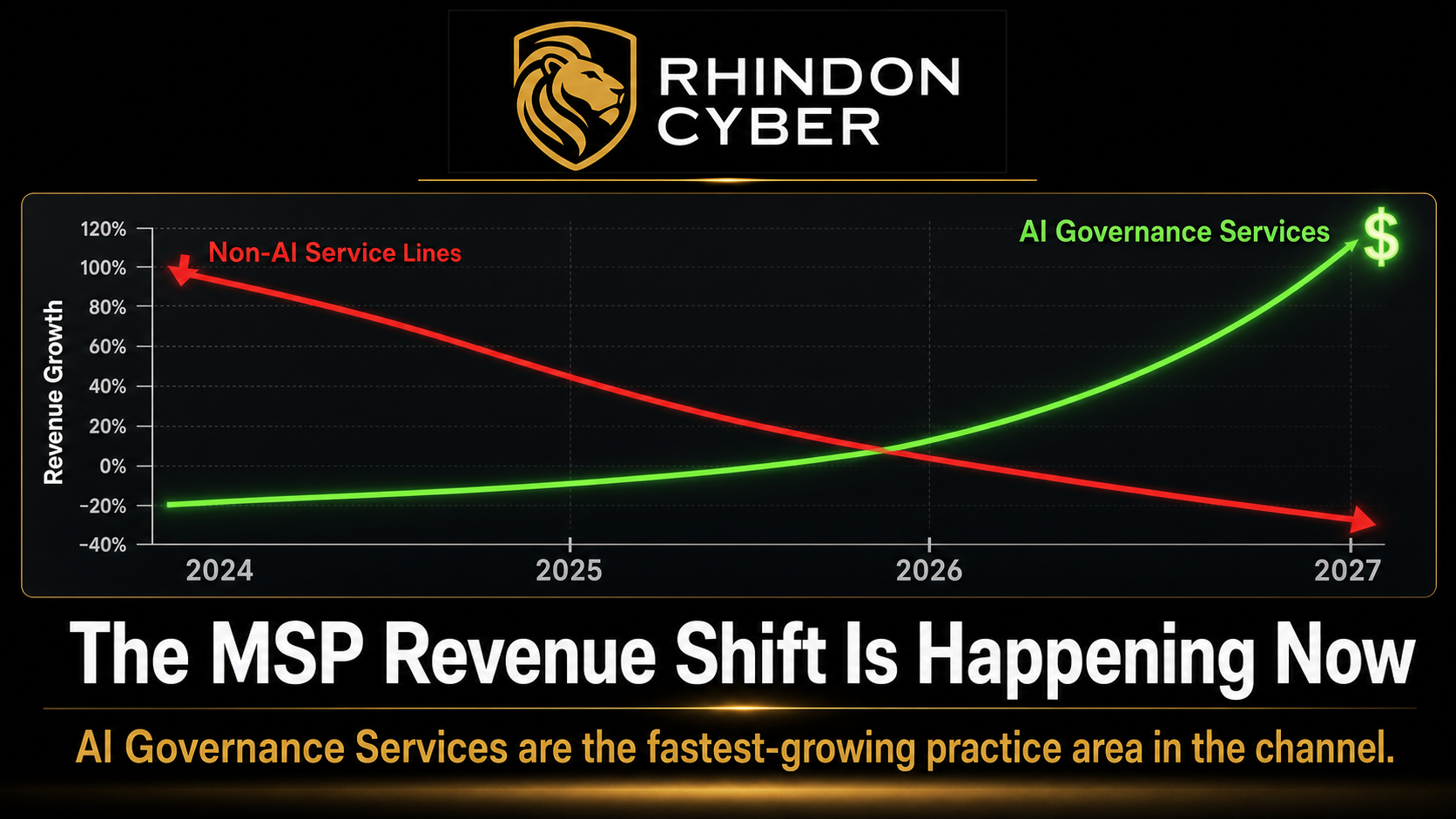
ConnectWise's (2026) MSP Industry Insights Report draws on responses from over 2,000 MSPs globally. It finds that compliance-focused MSPs are significantly more likely to project revenue growth of over 50% in 2026. This pattern is independently corroborated by Support Adventure's (2026) MSP industry benchmarks analysis.
The connection between compliance service expansion and revenue growth is not coincidental. Compliance services like cybersecurity assessments, vCISO services, and regulatory compliance programs are inherently recurring and inherently sticky. Clients who outsource compliance to an MSP renew at higher rates than clients who consume only infrastructure services. This is because compliance is a continuous obligation rather than a project with a completion date.
AI governance follows the same dynamic. A client's ISO 42001 alignment is not a one-time deliverable. It requires monthly monitoring, quarterly AI system inventory updates, annual governance reviews, and continuous shadow AI detection. These obligations map directly to recurring monthly or annual service fees.
Addressing the AI Readiness Gap
The AvePoint and Omdia (2026) research identifies an "intent-execution gap" among MSP clients. These are organizations that want to adopt AI but cannot because governance and compliance requirements are unresolved. The 51% of MSPs who cite governance as the primary adoption barrier are simultaneously describing a service opportunity. Every client who cannot adopt AI because of an unresolved governance gap is a potential AI governance managed service client.
MSP channel research from Acronis (2026) and Omdia projects the global managed security market will grow from $93 billion in 2025 to $106 billion in 2026, a 14.4% growth rate. Compliance and AI governance services are identified as a significant component of new revenue opportunity within this market.
MSPs that can demonstrate AI governance capability are positioned to convert this market expansion into actual revenue. This requires using a documented platform with client-facing reporting, framework-mapped findings, and a recurring delivery model.
Protecting MSP Margin Through Internal AI Governance
The business case is not only client-facing. Leading MSPs in 2026 are deploying AI internally before monetizing AI services externally. They are using it for service desk automation, threat detection, documentation, and workflow optimization. Acronis (2026) reports leading MSPs achieving 15–25% technician productivity gains and 40–70% reductions in ticket resolution times through AI adoption.
Internal AI governance ensures these productivity gains do not create compliance exposure. An MSP that uses AI in service delivery without documented governance creates liability risk if a client asks how their data was handled in an AI-assisted workflow.
The Eight Criteria for MSP-Ready AI Governance Software
The following criteria distinguish genuinely MSP-ready AI governance platforms from enterprise tools that have been adapted for, or simply marketed to, the MSP channel without meaningful architecture changes.
Criterion 1: Native Multi-Tenant Architecture
This is the foundational non-negotiable for any MSP tool. In the context of AI governance, multi-tenancy means the platform stores, processes, and reports client AI governance data in logically isolated environments.
Client A's AI system registry, risk assessments, shadow AI findings, and compliance reports are never accessible to client B's environment, to other MSP technicians without appropriate role-based access, or to the platform vendor without explicit authorization.
The operational test is straightforward: ask whether the platform was built multi-tenant from the ground up. Or was multi-tenancy achieved by creating separate customer accounts on a single-tenant architecture? The difference matters for scale. A single-tenant-by-design platform creates management overhead proportional to the number of clients—separate configurations, reports, and updates. A purpose-built multi-tenant platform manages the entire client portfolio from a single pane of glass with per-client configuration applied at the tenant level.
The AvePoint and Omdia (2026) research specifically identifies "multi-tenant visibility—centralized oversight allowing MSPs to detect drift, enforce policy changes, and monitor compliance posture without manual intervention per tenant" as one of the three operational imperatives for MSPs building AI governance services.
Criterion 2: Shadow AI Discovery at the Endpoint Level
An AI governance platform for MSPs must provide discovery that captures shadow AI—the unsanctioned AI tools that employees use outside IT's awareness. It cannot only catalog the AI tools that clients have formally approved. Industry data consistently finds that organizations use 3.2x more AI tools than appear in any sanctioned inventory. Standard network-layer or SaaS management discovery misses browser-based generative AI entirely because it leaves no installation footprint.
Effective shadow AI discovery at the MSP scale requires:
- Browser-level agent capability, deployed to managed endpoints as part of the MSP's standard endpoint management stack, surfacing AI tool usage directly from the browser where the majority of shadow AI occurs.
- Continuous discovery, not periodic scans but real-time or near-real-time inventory updates that reflect the current state of each client's AI environment, not a snapshot taken at assessment time.
- Portfolio-level visibility, the ability to see shadow AI trends and emerging tools across the entire client portfolio simultaneously, identifying tools entering the environment across multiple clients before they become governance incidents.
IBM Security (2025) found that 20% of organizations experienced data breaches caused by shadow AI in 2025. Those breaches cost an average of $670,000 more than standard breaches. For MSPs with multiple clients in regulated industries, the liability and reputational exposure from undetected shadow AI incidents is a service quality and business continuity risk, not only a client compliance problem.
Criterion 3: Framework-Mapped Compliance Reporting
AI governance findings are actionable only when they are expressed in the language of the frameworks clients are accountable to. Most MSP clients in 2026 face questions about AI governance from three directions:
- Their cyber insurers
- Their enterprise clients' vendor due diligence processes
- Emerging regulatory requirements
Each uses different language and maps to different control sets.
An MSP-ready AI governance platform must generate compliance reports that map findings simultaneously to:
- NIST AI RMF 1.0 (NIST, 2023): Govern, Map, Measure, Manage functions with core and subcategories, for U.S.-focused clients and government contractors
- ISO/IEC 42001:2023 (ISO, 2023): Clause-by-clause alignment and Annex A control mapping, for clients pursuing certification or subject to enterprise supply chain AI governance requirements
- EU AI Act (European Parliament & Council of the European Union, 2024): Article 4 (AI literacy), Article 26 (deployer obligations), Article 50 (transparency) for clients with EU market exposure or European parent companies
The ability to generate these reports without requiring the MSP to manually translate findings into each framework's language is the difference between a scalable service and an hourly billing exercise. As the IDC MarketScape (2025) notes, leading AI governance platforms "automate compliance with global AI governance standards through policy management, risk assessment, and audit trails." The automation is what makes the economics work at MSP scale.
Criterion 4: Client-Ready Reporting at the Right Reading Level
AI governance software designed for enterprise data scientists produces reports written for enterprise data scientists. MSP clients—SMBs in professional services, healthcare, legal, financial services, manufacturing—need governance findings expressed in plain business language. They need clear action items, prioritized by risk level, in a format they can share with their leadership team, their cyber insurer, or their largest enterprise client.
The evaluation criteria:
- Executive summary layer—a one-page or dashboard-level view showing overall AI governance posture, top risks by priority, and compliance status against applicable frameworks
- Evidence package layer—the underlying documentation, risk assessments, and audit logs that satisfy framework requirements and survive external audit or due diligence review
- Action item layer—specific, prioritized remediation recommendations expressed in plain language, mapped to the specific risk or framework gap they address
The Asante-Gyasi et al. (2025) finding that social innovation—embedding governance into organizational processes—moderates governance effectiveness is operationally relevant here. Client-facing reports that get used are readable, actionable, and integrated into the client's existing decision-making rhythm. Reports that live in a portal that clients open once a quarter do not change organizational behavior.
Criterion 5: AI Literacy Program Support
EU AI Act Article 4 requires that deployers of AI systems ensure their staff possess sufficient AI literacy. This is defined as the skills, knowledge, and understanding to use AI systems appropriately with awareness of the opportunities and risks (European Parliament & Council of the European Union, 2024). ISO 42001 Clause 7 requires competence and awareness programs.
For MSPs delivering AI governance as a managed service, AI literacy support is a compliance-driven requirement for clients in EU-market-exposed industries and a best-practice requirement for all others.
MSP-ready AI governance platforms should provide:
- AI literacy training content accessible within the platform, or API integration with the MSP's existing training platform
- Completion tracking and documentation by employee, by role, and by client tenant—producing the evidence record that satisfies Article 4 and Clause 7 requirements
- AUP (Acceptable Use Policy) management—the ability to publish, version, and track acknowledgment of the client's AI Acceptable Use Policy within the governance platform
AI literacy infrastructure that the MSP can deploy and manage across all client tenants without building separate programs per client is a scalability multiplier. It allows a single investment in literacy content to be amortized across the entire client portfolio.
Criterion 6: AI System Registry as a Living Document
The AI system registry is the operational core of ISO 42001 and NIST AI RMF compliance. It is a continuously updated inventory of all AI systems in use within an organization, including purpose, data handling, risk classification, and governance status. It is also the document that gets requested first in vendor due diligence questionnaires, cyber insurance applications, and regulatory audits.
Clients who cannot produce it immediately are demonstrating, in the most visible way possible, that their AI governance program does not exist.
For MSPs, a platform that auto-populates and continuously updates the AI system registry is the difference between a governance service that scales and one that requires constant manual maintenance. It should update from shadow AI discovery, from integration with identity and access management systems, and from MSP-provided inputs.
The registry's minimum required fields, based on ISO 42001 Annex A.4 requirements, are: system name, vendor, purpose, data classification handled, primary users, risk tier, governance status (approved/under review/flagged), and last review date. Platforms that capture these fields automatically through discovery—rather than requiring manual entry—reduce MSP technician time and increase data accuracy.
Criterion 7: Incident Detection and Response Workflow
Shadow AI incidents require a structured response workflow, not just a detection alert. These incidents include data submitted to unsanctioned tools, AI-generated outputs used in consequential decisions without oversight, and policy violations.
MSP-ready AI governance platforms must provide:
- Alert routing—governance incidents routed to the appropriate MSP technician and client contact based on severity and type
- Incident documentation—automatic capture of incident details (tool involved, data classification, user, timestamp, detection method) in a format that satisfies regulatory reporting requirements
- Remediation tracking—workflow that tracks an incident from detection through assessment, remediation, and closure with evidence at each stage
- Escalation paths—criteria-based escalation for incidents that may require regulatory notification (e.g., suspected HIPAA-relevant data exposure to an unsanctioned AI tool)
The procedural governance dimension identified by Papagiannidis et al. (2024)—operational workflows, audit, continuous improvement—is where most AI governance implementations fail. Platforms that provide automated incident detection without structured response workflows shift the governance burden from the tool to the technician. At MSP scale, with multiple clients and a limited technician team, that burden accumulates quickly.
Criterion 8: Integration with the MSP Stack
AI governance software that operates as a silo creates adoption friction that undermines service delivery. Separate logins, separate workflows, and separate reporting are inefficient. MSP-ready platforms must integrate with the tools that MSP technicians use every day:
- PSA integration (ConnectWise, Autotask, HaloPSA)—governance incidents and action items create tickets automatically; ticket status updates reflect in the governance platform.
- RMM integration (Datto RMM, N-able, Kaseya)—the endpoint agent for shadow AI discovery deploys through the existing RMM stack; device compliance status feeds into governance assessments.
- SIEM/SOAR integration—AI governance incidents flow into the existing security event pipeline; governance data enriches security context for AI-related incidents.
- Identity provider integration (Azure AD, Okta, Google Workspace)—OAuth grant visibility surfaces SaaS AI tool adoption; user records power AI literacy training tracking.
Integration depth determines whether AI governance is a standalone service requiring separate effort or an integrated capability that amplifies the value of the MSP's existing service stack.
The Multi-Tenant Imperative: Why Single-Tenant Tools Fail MSPs
The multi-tenant architecture requirement deserves deeper treatment because it is the most common point of failure when MSPs adopt enterprise AI governance tools.
Enterprise AI governance platforms are designed for a single organization with a large, dedicated governance team. Their architecture reflects this with a single policy set, risk framework configuration, reporting structure, and AI system registry. Adapting this architecture for multi-client MSP delivery requires either creating a separate instance per client (which defeats the economics) or using account-level separation within a shared instance (which creates data governance risk and cross-client visibility concerns).
Birkstedt et al.'s (2023) finding in Internet Research applies at the MSP level: governance that is operationally cumbersome does not get consistently executed. If an MSP technician must navigate five different platform instances to review the AI governance status of five clients, the review cadence slips. Governance incidents go undetected. The service value erodes.
Purpose-built multi-tenant architecture solves this. All clients are visible from a single dashboard. Policy templates cascade from the MSP-level baseline to client tenants with per-client customization. Compliance reporting generates per-client documentation from a unified data model.
At 10 clients, the operational difference between single-tenant and multi-tenant architecture is manageable. At 50 clients, it determines whether the service is profitable.
Framework Alignment: NIST AI RMF, ISO 42001, and EU AI Act in One Platform
MSP clients in 2026 will be questioned about AI governance by counterparties using three different frameworks, often in the same month. A healthcare SMB completing a vendor questionnaire for a hospital system may face NIST AI RMF questions. The same firm's cyber insurer may ask about ISO 42001 alignment. If the firm has EU clients, EU AI Act deployer compliance will be on the agenda.
The MSP that can answer all three questions from a single governance program is delivering significant value. Being able to produce framework-specific documentation for each saves clients both money and organizational stress.
The alignment between the three frameworks at the control level is substantial:
| Governance Requirement | NIST AI RMF | ISO 42001 | EU AI Act |
|---|---|---|---|
| AI system inventory | Map: AI system context | Clause 6 + Annex A.4 | Article 26 (documenting AI systems) |
| Risk assessment | Measure: quantitative/qualitative | Clause 6.1 | Article 9 (risk management) |
| Human oversight | Govern: policies for human review | Annex A.9 | Article 14 (human oversight) |
| AI literacy / training | Govern: AI culture and workforce | Clause 7.2–7.3 | Article 4 (AI literacy) |
| Incident management | Manage: risk treatment | Clause 10.1 | Article 26 (post-market monitoring) |
| Transparency documentation | Govern: accountability | Annex A.6 | Article 50 (transparency) |
| Continuous monitoring | Manage: ongoing monitoring | Clause 9.1 | Article 26 (continuous monitoring) |
An AI governance platform that maps its output to all three frameworks simultaneously converts what would be a significant labor cost into an automated reporting function. It should not require the MSP to manually cross-reference findings against each framework. As the IDC MarketScape (2025) notes, leading platforms provide "out-of-the-box regulatory intelligence, tracking and translating global regulations into machine-readable controls and harmonized frameworks."
Shadow AI Detection as a Core MSP Service
Shadow AI detection deserves specific treatment as an MSP service offering. This is because it has the clearest and most immediate client value proposition of any AI governance capability. Unlike policy documentation or framework alignment, which deliver value over months and through external audits, shadow AI detection delivers immediate, visible findings at the first scan.
The Discovery Scan Entry Point
For most SMB clients, the first shadow AI discovery scan will reveal tools they did not know their employees were using. Schwaeke et al.'s (2025) systematic review of 106 peer-reviewed studies identifies resource constraints, limited IT governance infrastructure, and low AI literacy as primary drivers of ungoverned AI proliferation in small firms. These conditions make shadow AI disproportionately hard to surface without a dedicated discovery tool.
The discovery findings are immediately compelling to any client concerned about data protection, regulatory compliance, or cyber insurance obligations. They answer questions like: What AI tools are your employees using? What data are they exposing? What is the risk level?
This creates a natural service entry point. An MSP can offer a free or low-cost shadow AI discovery scan as a lead-generation tool, deliver the findings in a client-ready report, and convert the discovery outcome into a paid AI governance managed service engagement. The MSP channel has successfully used this model for security assessments, dark web monitoring scans, and Microsoft 365 security posture reviews. Shadow AI discovery is the AI governance equivalent.
The Ongoing Managed Service Value
The ongoing service value is equally clear: shadow AI is not a static problem. New AI tools launch continuously. Employees cycle through organizations. The tool landscape evolves faster than any periodic assessment can track.
A managed detection service provides continuous visibility and has a clear client retention rationale. It alerts when new high-risk tools enter a client environment and provides recurring service economics.
The Audit Trail and Reporting Engine: What Clients and Regulators Need to See
The documentation dimension of AI governance is where governance programs either survive or fail external scrutiny. This includes what gets recorded, how it is organized, and how long it is retained. Laine et al. (2024) identify "guidance, methods and tools, and awareness and empowerment" as the three knowledge contributions that AI auditing must provide stakeholders. The documentation engine of an AI governance platform is the mechanism that produces all three.
For MSP-managed AI governance, the audit trail must satisfy four audiences simultaneously:
1. Client leadership—needs a clear, current picture of AI governance posture: what systems are governed, what risks are known, what actions are underway, and what the overall compliance status is against applicable frameworks.
2. Cyber insurers—need documented evidence of AI governance program existence and operational maturity: policies in place, training completed, shadow AI monitored, incidents recorded and remediated.
3. Enterprise client due diligence—needs an AI system registry, evidence of risk assessments, documentation of human oversight procedures, and attestation of regulatory compliance, typically in a structured format that can be submitted as part of vendor qualification.
4. Regulatory bodies—need timestamped, immutable records of governance activities: when assessments were conducted, what findings were identified, what remediation was taken, and who was responsible, all in a format that demonstrates both the existence and the operation of the governance program.
Platforms that provide immutable audit logs are qualitatively more valuable than platforms that allow records to be updated or deleted. These are records that cannot be retroactively altered after a governance incident. In a regulatory proceeding or insurance claim, the ability to demonstrate that governance activities occurred before an incident, not in response to it, is often the determining factor in the outcome.
Evaluation Checklist: 25 Questions to Ask Any AI Governance Vendor
Before committing to any AI governance platform for MSP delivery, use this checklist to assess genuine MSP readiness. Answers to these questions surface architecture and operational gaps that marketing materials typically do not disclose.
Architecture and Multi-Tenancy
- Was the platform built multi-tenant from the ground up, or was multi-tenancy added to a single-tenant architecture?
- What is the maximum number of client tenants the platform has managed for a single MSP partner?
- How is client data isolated—at the database level, the application level, or the network level?
- Can an MSP technician view all client AI governance postures from a single dashboard without switching between client instances?
- What role-based access controls exist for MSP technicians, client administrators, and client end users?
Shadow AI Discovery
- Does the platform include a browser extension agent for endpoint-level AI discovery, or does it rely on network-layer or DNS-based detection only?
- How frequently is the AI system registry updated from discovery data—in real time, hourly, daily?
- What percentage of browser-based generative AI tools does the discovery mechanism capture in a standard enterprise environment?
- How does the platform handle AI tools embedded within other SaaS applications (e.g., Grammarly embedded in Outlook, AI features within Salesforce)?
- Can the platform detect personal device AI usage, or is discovery limited to managed endpoints?
Compliance Reporting and Framework Alignment
- Which frameworks are natively supported in compliance reporting output (NIST AI RMF, ISO 42001, EU AI Act, HIPAA, SOC 2, CMMC)?
- Are compliance reports generated automatically from governance data, or do they require manual mapping by the MSP technician?
- How frequently is the regulatory intelligence updated as frameworks evolve?
- Can framework-specific reports be white-labeled with MSP branding for client delivery?
- Does the platform provide a Statement of Applicability template for ISO 42001 certification support?
Incident Detection and Response
- Does the platform detect shadow AI incidents in real time, or only through periodic assessment?
- How are incidents routed—to the MSP technician, the client contact, or both?
- Does the platform provide immutable audit logs that cannot be retroactively modified?
- What incident types does the platform detect: shadow AI discovery, data classification violations, policy violations, AUP breaches, anomalous AI usage patterns?
- How does the platform support regulatory notification workflows when a potential HIPAA or GDPR breach via shadow AI is suspected?
Integration and MSP Stack Compatibility
- Which PSA platforms does the platform integrate with natively (ConnectWise, Autotask, HaloPSA)?
- Which RMM platforms does the browser extension agent support for deployment (Datto RMM, N-able, Kaseya)?
- Does the platform integrate with Azure AD and Okta for OAuth grant visibility and user-based governance tracking?
- What is the API documentation depth—can MSPs build custom integrations or export governance data to their existing security tooling?
- What is the deployment timeline from agreement to first client tenant operational—days or weeks?
How RAIC Is Built for the MSP Delivery Model
RAIC (AI Risk & Integrity Cloud) by Rhindon Cyber was designed from the ground up as a multi-tenant AI governance platform for MSPs and their SMB clients. Every architecture decision—from the browser extension discovery agent to the framework-mapped compliance reporting engine—reflects the operational requirements of MSP delivery at scale.
Native Multi-Tenant Architecture with Portfolio-Level Visibility
RAIC's multi-tenant architecture provides MSPs with a single-pane-of-glass view across all client tenants. From the portfolio level, they can see AI governance posture scores, shadow AI findings, compliance status against key frameworks, and open action items without switching between client instances.
Client data is isolated at the tenant level with role-based access controls that distinguish MSP administrator, MSP technician, client administrator, and client read-only access levels. This architecture directly addresses the standardization and multi-tenant visibility imperatives identified by AvePoint and Omdia (2026) as operational requirements for scalable AI governance services.
Browser Extension Shadow AI Discovery Across the Client Portfolio
RAIC's browser extension agent deploys to managed client endpoints through the MSP's existing RMM stack, with no separate deployment project required. The agent surfaces AI tool usage in real time, populating the per-client AI system registry with discovered tools. This includes their risk classification, data exposure profile, and vendor security status. New tools entering a client environment trigger alerts at both the MSP technician and client administrator levels before they become governance incidents.
Unified Compliance Reporting: NIST, ISO 42001, EU AI Act
RAIC generates per-client compliance reports mapped simultaneously to NIST AI RMF core functions, ISO 42001 clause-by-clause requirements, and EU AI Act deployer obligations. This happens automatically from a single governance data model.
Reports are white-label ready for MSP delivery and include:
- MSP branding
- Client-specific findings
- Executive summary layer for client leadership
- Evidence package layer for certification audits, cyber insurance, and enterprise due diligence
MSP Portal: Recurring Service Delivery Infrastructure
RAIC's MSP portal provides the billing, client management, and service delivery infrastructure for AI governance as a recurring managed service. Client onboarding workflows, recurring assessment schedules, compliance status dashboards, and client-facing reporting are all managed from the MSP's administrative environment.
Five Service Lines and Three Revenue Layers
RAIC structures MSP delivery around five productized service lines, each mapped to a defined client pain point and revenue model:
| Service Line | Client Pain Point | Revenue Model |
|---|---|---|
| AI Discovery & Shadow AI Assessment | Clients don't know what AI tools are in use across browsers, SaaS, and Microsoft 365 | Fixed-fee engagement + monthly monitoring retainer |
| ISO 42001 Readiness & Implementation | Clients want certification but can't staff the AIMS build, Annex A controls, or internal audit | Fixed-fee readiness + ongoing AIMS operations retainer |
| EU AI Act Compliance Advisory | Cross-border clients need Provider/Deployer scoping and Annex IV/XI/XII/XIII evidence packs | Scoping engagement + annual pack refresh |
| Virtual AI Risk Officer (vAIRO) | No internal AI Risk Officer, governance cadence, board reporting, or AI policy lifecycle | Monthly retainer per client; vCAIO advisory and policy attestation layer in here |
| External Audit Delivery | Clients need independent ISO 42001 audit using the isolated ExternalAuditor workspace | Annual audit engagement, repeatable across the book |
These five service lines roll up into three billing layers that stack inside an MSP's SOW:
- Assessment engagements—Shadow AI audit, ISO 42001 readiness, EU AI Act actor scoping. Project-fee billings of $2,500–$60,000 per engagement.
- Managed Governance retainer—vAIRO cadence including governance reports, review tracking, and the Anonymous Concerns Channel. $500–$2,500 per client per month.
- vCAIO + Cyber bundle—Board-level AI strategy and reporting packaged with the MSP's existing cyber retainer for blended uplift.
Two Licensing Paths
MSPs can monetize RAIC through either of two commercial models—or both in parallel:
- Model A (MSP resell): The MSP purchases RAIC licenses at partner pricing (tiered at 10/25/50+ tenants), sets the markup, and bundles the platform into a managed AI governance service. International billing is built in across the US, CA, GB, AU, and IN. Every partner firm receives a free NFR demo sandbox (up to 5 users) and a free Enterprise tenant for internal operations when they bring on a paying Pro or Enterprise client.
- Model B (Client-direct): The client holds the RAIC subscription directly. The MSP delivers the assessment, vAIRO, vCAIO, audit-prep, or annex-pack engagement as a services layer on top. This model presents lower commercial risk for the MSP and allows for faster procurement for the client.
Ready to add AI governance to your MSP service stack? Request a free RAIC MSP Partner Demo at raic.rhindoncyber.com. See the multi-tenant portfolio dashboard, the shadow AI discovery agent in action, and the framework-mapped compliance report for a sample client environment.
References
Acronis. (2026). MSP report 2026: The state of managed services. Acronis International. acronis.com/en-us/resource-center/resource/msp-report-2026
Asante-Gyasi, K. O., Asiamah, O., & Danso, K. O. (2025). Artificial intelligence (AI) governance in organizational decision making: The impact of autonomy, transparency and accountability. Journal of Enterprise and Policy Practice. Advance online publication. doi.org/10.1108/JEPP-04-2025-0112
AvePoint & Omdia. (2026). The road to AI readiness: Unlocking the MSP AI opportunity through governance [Research report]. AvePoint. globenewswire.com/news-release/2026/04/09/3271007/0/en/Research-From-AvePoint-and-Omdia-Reveals-Governance-and-Compliance-as-the-Leading-AI-Adoption-Barrier-Among-MSPs.html
Birkstedt, T., Minkkinen, M., Tandon, A., & Mäntymäki, M. (2023). AI governance: Themes, knowledge gaps and future agendas. Internet Research, 33(7), 133–167. doi.org/10.1108/INTR-01-2022-0042
European Parliament & Council of the European Union. (2024, July 12). Regulation (EU) 2024/1689 laying down harmonised rules on artificial intelligence (Artificial Intelligence Act). Official Journal of the European Union. eur-lex.europa.eu/eli/reg/2024/1689/oj
Gillespie, N., Lockey, S., Ward, T., Macdade, A., & Hassed, G. (2025). Trust, attitudes and use of artificial intelligence: A global study 2025. The University of Melbourne and KPMG. doi.org/10.26188/28822919
IBM Security. (2025). Cost of a data breach report 2025. IBM Corporation. ibm.com/reports/data-breach
IDC. (2025). IDC MarketScape: Worldwide unified AI governance platforms 2025 vendor assessment (Doc No. US51439824). IDC. idc.com/getdoc.jsp
International Organization for Standardization. (2023). ISO/IEC 42001:2023 — Information technology — Artificial intelligence — Management system. ISO. iso.org/standard/81230.html
Laine, J., Minkkinen, M., & Mäntymäki, M. (2024). Ethics-based AI auditing: A systematic literature review on conceptualizations of ethical principles and knowledge contributions to stakeholders. Information & Management, 61(5), Article 103969. doi.org/10.1016/j.im.2024.103969
Mäntymäki, M., Minkkinen, M., Birkstedt, T., & Viljanen, M. (2022). Defining organizational AI governance. AI and Ethics, 2, 603–609. doi.org/10.1007/s43681-022-00143-x
National Institute of Standards and Technology. (2023, January 26). Artificial intelligence risk management framework (AI RMF 1.0) (NIST AI 100-1). U.S. Department of Commerce. doi.org/10.6028/NIST.AI.100-1
Papagiannidis, E., Mikalef, P., & Conboy, K. (2024). Responsible artificial intelligence governance: A review and research framework. Journal of Strategic Information Systems, 34(2), Article 101885. doi.org/10.1016/j.jsis.2024.101885
ConnectWise. (2026). MSP industry insights report 2026. ConnectWise. connectwise.com/resources/msp-insights-report
Support Adventure. (2026). MSP industry benchmarks in 2026: Statistics and future trends. Support Adventure. supportadventure.com/msp-industry-trends-2026
Schwaeke, J., Peters, A., Kanbach, D. K., Kraus, S., & Jones, P. (2025). The new normal: The status quo of AI adoption in SMEs. Journal of Small Business Management, 63(3), 1297–1331. doi.org/10.1080/00472778.2024.2379999
Zavodna, L. S., Überwimmer, M., & Frankus, E. (2024). Barriers to the implementation of artificial intelligence in small and medium-sized enterprises: Pilot study. Journal of Economics and Management, 46(1), 331–352. doi.org/10.22367/jem.2024.46.13
This article was written by David Mosher, CEO of Rhindon Cyber and publisher of the Pragmatic Cybersecurity newsletter. Rhindon Cyber builds AI governance and risk management tools for SMBs and managed service providers. RAIC is available at raic.rhindoncyber.com.
FAQ
What is AI governance software for MSPs?
AI governance software for MSPs is a platform that enables managed service providers to deliver AI governance, risk assessment, shadow AI detection, and compliance reporting to multiple client organizations from a single multi-tenant interface. It differs from enterprise AI governance tools by providing multi-tenant architecture, client-ready reporting, MSP-stack integration, and the scalable economics of a managed service delivery model.
Why is multi-tenancy the most important architectural requirement for MSP AI governance tools?
Multi-tenancy determines whether an AI governance service is profitable at scale. Single-tenant architectures — whether separate platform instances per client or account-level separation in a shared instance — create management overhead that grows proportionally with the number of clients. A purpose-built multi-tenant platform allows a single MSP technician to monitor the AI governance posture of 50 clients from one dashboard, making the service economically viable. AvePoint and Omdia (2026) identify multi-tenant visibility as one of the three operational imperatives for MSPs building AI governance services.
What is the business case for MSPs adding AI governance as a service?
Three revenue streams: (1) recurring managed service fees from ongoing shadow AI detection, governance reporting, and compliance program maintenance; (2) project revenue from initial assessments, gap analyses, and ISO 42001 certification support; (3) client retention — compliance-focused MSPs are significantly more likely to project revenue growth over 50% in 2026 (ConnectWise, 2026; Support Adventure, 2026) because compliance services are sticky, recurring, and renewal-driven in ways that infrastructure services are not.
What AI governance frameworks should MSP clients be aligned to?
The three frameworks that appear most frequently in enterprise vendor due diligence, cyber insurance underwriting, and regulatory compliance contexts are NIST AI RMF 1.0 (NIST, 2023), ISO/IEC 42001:2023 (ISO, 2023), and the EU AI Act (European Parliament & Council of the European Union, 2024). MSP clients in healthcare add HIPAA AI governance considerations; those in government contracting add CMMC AI-relevant controls; those in financial services add SEC and FINRA AI guidance. An MSP AI governance platform should map findings to all relevant frameworks from a single governance data model.
How does shadow AI discovery fit into an MSP AI governance service?
Shadow AI discovery is the entry point and the ongoing core of an AI governance managed service. Most SMB clients have no accurate picture of the AI tools their employees use; discovery provides immediate, visible findings that justify both the initial engagement and the ongoing service. IBM Security (2025) found that 20% of organizations experienced breaches caused by shadow AI, with a $670,000 breach cost premium — the discovery findings translate directly into client risk language that makes the service value concrete.
What does AI governance software need to do that security tools cannot?
Security tools (EDR, SIEM, SASE) detect threats and incidents in AI systems. AI governance software manages the organizational governance program that determines which AI systems are authorized, how they are used, what data they can access, how their outputs are reviewed, and how the organization demonstrates compliance with applicable frameworks. The two categories are complementary: security tools are reactive (detecting breaches), governance tools are proactive (preventing governance failures that lead to breaches). The IBM Security (2025) finding that the shadow AI breach cost premium is $670,000 reflects the cost of absent governance, not absent security detection.
How is RAIC designed specifically for the MSP delivery model?
RAIC provides native multi-tenant architecture with portfolio-level visibility, a browser extension shadow AI discovery agent that deploys through existing RMM stacks, framework-mapped compliance reporting across NIST AI RMF, ISO 42001, and EU AI Act simultaneously, white-label client reporting, PSA and RMM integrations, and an MSP portal for recurring service delivery management. Each capability reflects a specific MSP operational requirement — the platform was designed for MSP delivery, not adapted from an enterprise product. Request an MSP partner demo at [raic.rhindoncyber.com](https://raic.rhindoncyber.com).
What is the first AI governance service an MSP should offer clients?
Shadow AI discovery is the strongest entry point: lowest barrier to client agreement (the first scan is typically a no-cost assessment), highest immediate value (clients learn what AI tools their employees are using for the first time), and clearest conversion path (discovery findings justify the ongoing governance service). The ConnectWise (2026) MSP Industry Insights Report and AvePoint and Omdia (2026) research both identify governance as the primary AI service demand signal from SMB clients — shadow AI discovery is the most immediate and tangible expression of that demand.
Bring AI governance into one platform
Start a free trial of RAIC and operationalize the practices in this article.
Start trial