
MSP White-Label AI Governance: How Managed Service Providers Can Own the AI Governance Conversation in 2026
MSP White-Label AI Governance: How Managed Service Providers Can Own the AI Governance Conversation in 2026
The global AI governance market is expanding at a 38.5% CAGR and is projected to reach $4.2 billion by 2033. The MSPs that build a white-label AI governance practice today will own the recurring revenue streams that come with it for the next decade.
What Is MSP White-Label AI Governance?
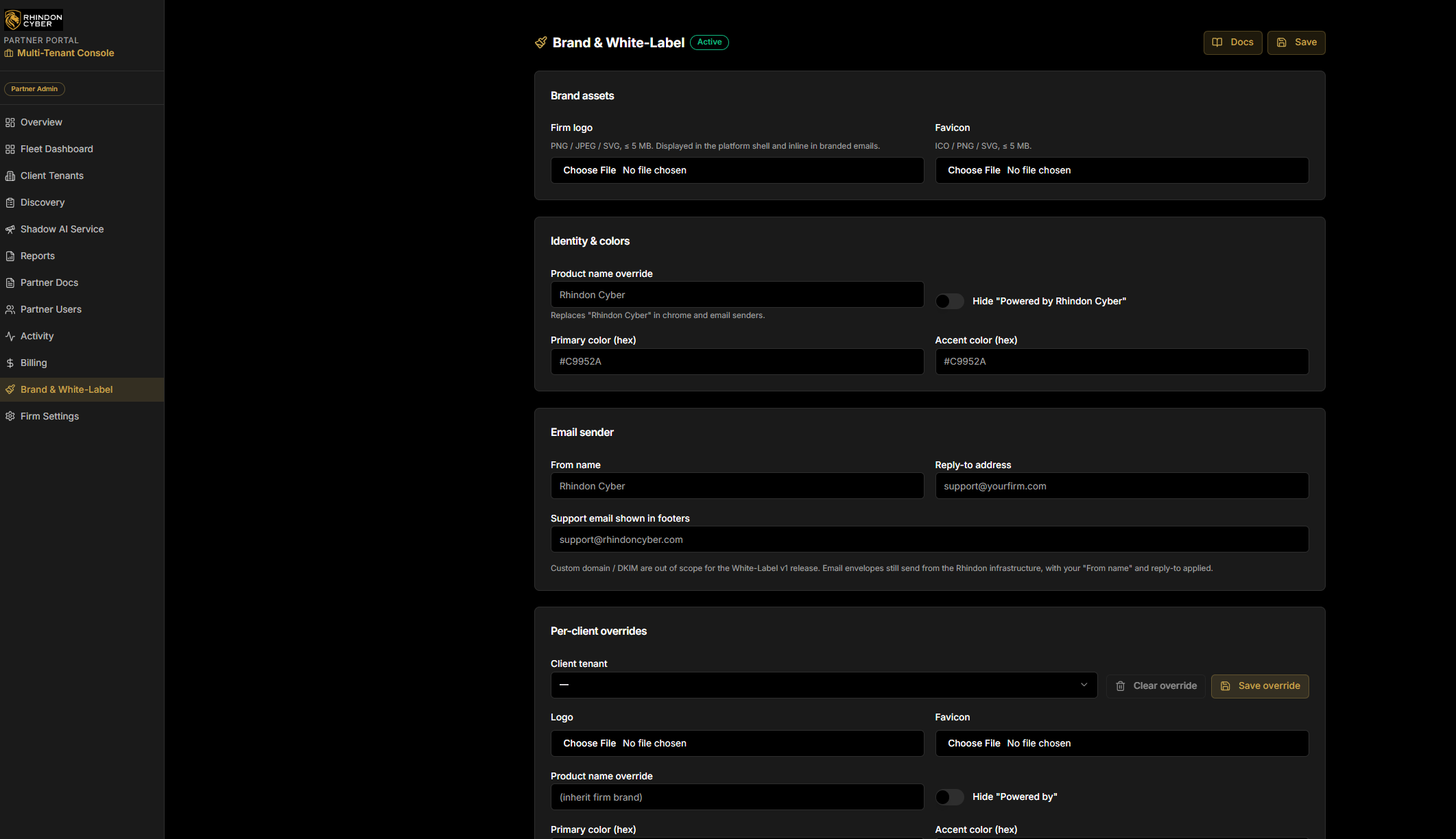
MSP white-label AI governance is the practice of delivering a fully branded AI governance, risk, and compliance (GRC) platform to clients under your firm's own logo, domain, and color scheme — without building the underlying technology yourself.
Instead of investing 18+ months building a multi-tenant AI management system from scratch, managed service providers license a pre-built platform, apply their branding across the entire user interface and all client-facing exports, and deliver enterprise-grade AI governance as a proprietary service.
The result: clients interact only with your brand. Every report, every notification, every dashboard carries your firm's identity — not the platform vendor's.
Why AI Governance Is the Defining MSP Opportunity of 2026
Unsanctioned AI use is the new shadow IT — and it's moving faster than IT teams can respond.
A peer-reviewed study of shadow AI in regulated enterprises found that unsanctioned generative AI tools create governance drift, audit gaps, and data disclosure risk — with small and mid-sized businesses facing disproportionately high exposure relative to their IT resources (Agarwal & Arya, 2026). ChatGPT, Copilot, Gemini, and hundreds of other AI services are already active in your clients' environments — undiscovered, unmapped, and unapproved.
That gap is not a problem your clients can close alone. It's a managed service.
The regulatory backdrop makes it urgent. The EU AI Act is now in active enforcement — provider and deployer penalties reach €35 million or 7% of global annual turnover (LegalNodes, 2026). ISO/IEC 42001 certification is moving from optional to RFP-mandatory in financial services, healthcare, and defense contracting (ISMS.online, 2025). MSPs who deliver AI governance now are solving an immediate compliance crisis, not pitching a future consideration.
As one channel analyst observed in May 2026: "I would say the biggest winners of the [AI] opportunity are going to be the MSPs that figure it out between now and the end of the year — they're going to be able to grab so much market share from the other MSPs who are not figuring it out now" (Rama, 2026).
What Managed Service Providers Get with White-Label AI Governance
A purpose-built white-label AI governance platform gives MSPs a complete, deployable service line — not just a tool to resell.
-
Full Brand Control Across Every Client Touchpoint: Your logo, favicon, accent color, and company footer appear across every client tenant interface, every exported document (DOCX, XLSX, CSV), and every outbound compliance notification your clients receive. Clients never see a third-party vendor name.
-
Production-Ready Multi-Tenant Architecture: A properly built platform isolates every client's data at the record level, with row-level security that makes cross-tenant data exposure architecturally impossible. Your consulting team operates as invited admins — not shared super-users. As your client count scales from 5 to 50 to 500, the infrastructure scales with it.
-
Framework Coverage Out of the Box: Enterprise-grade AI governance means covering the frameworks your clients will actually be audited against: ISO/IEC 42001 (all 38 Annex A controls), the EU AI Act (provider, deployer, importer, and distributor roles), and the NIST AI Risk Management Framework (NIST, 2023). Building this yourself requires months of framework mapping, control authoring, and evidence pack development. A white-label platform delivers it on day one.
-
Branded Shadow AI Discovery: The browser extension that detects unsanctioned AI use — across 264+ services including ChatGPT, Copilot, Gemini, Claude, and model-level invocations — installs under your firm's name. Your brand is the first thing a client employee sees when the extension activates.
-
Partner Enablement Infrastructure: A well-designed MSP program includes a free, non-production Enterprise demo tenant for client sales demonstrations and consultant training. Landing your first paying client unlocks a complimentary Enterprise tenant for your own firm's internal governance. Your MSP admin seats don't consume client license capacity.
The 3-Layer AI Governance Practice Model
MSPs who build on a white-label AI governance platform have a clear three-layer revenue architecture available from day one.
-
Layer 1 — Project Engagements ($2,500–$15,000 per engagement): AI Discovery assessments, Shadow AI audits, ISO 42001 readiness reviews, and EU AI Act actor-role scoping are all high-value, one-time projects that create the foundation for ongoing retainers. Every deliverable ships as a branded report under your firm's name.
-
Layer 2 — Managed AI Governance Retainers ($500–$2,500 per client per month): Once clients are onboarded, the ongoing governance function — monthly risk reports, AI system registry maintenance, review tracking, and anonymous employee concerns channels — becomes a managed retainer. This is the same recurring revenue model MSPs already use for managed security. AI governance retainers layer directly on top.
-
Layer 3 — vCAIO and Cybersecurity Bundling: The most advanced MSPs are bundling AI governance with existing cybersecurity retainers to expand deal size without expanding the sales motion. Adding a virtual Chief AI Officer (vCAIO) function — or delivering external ISO 42001 audit services through an isolated Auditor workspace — creates a premium service tier that competitors without the platform infrastructure cannot match.
The RAIC White-Label MSP Program
RAIC (AI Risk & Integrity Cloud) from Rhindon Cyber is purpose-built for MSPs who want to deliver white-label AI governance without building the infrastructure themselves.
The MSP White-Label add-on is $99 USD per month per firm — covering unlimited client tenants, unlimited branded exports, branded outbound email, and partner-branded extension installs. Client licenses are Starter ($349/mo), Professional ($999/mo), or Enterprise ($1,800/mo), resellable with margin or billed alongside services.
Every MSP partner receives up to 20 free MSP admin seats, a free non-production Enterprise demo tenant, and a free Enterprise tenant upon landing the first paying client.
HOW TO LAUNCH A WHITE-LABEL AI GOVERNANCE SERVICE IN 30 DAYS
- Week 1, set up your brand: Add your logo, colors and email domain so reports and client emails carry your name, not ours.
- Week 1, build your starter kit: Rebrand the free AI Acceptable Use Policy template and the Shadow AI detection checklist as your first client deliverables.
- Week 2, run it on yourself: Use your free demo tenant to run discovery, a policy and a risk register for your own firm. That becomes your sales demo.
- Week 3, pilot with one client: Pick a client already asking about AI. Deliver a Shadow AI findings report and a signed policy.
- Week 4, package and price: Turn the pilot into a monthly service line and offer it to your next five clients.
WHAT TO PACKAGE: SIX SERVICE LINES
These are the six service lines RAIC partners productize. Start with one, then scale across your book of business.
| Service line | Client problem it solves | Typical engagement size |
|---|---|---|
| AI Discovery & Shadow AI Assessment | Clients don't know what AI is in use across browsers, SaaS and Microsoft 365 | $2.5K – $5K |
| ISO 42001 Readiness & Implementation | Clients want certification but can't staff the AI management system build | $15K – $60K |
| EU AI Act Compliance Advisory | Cross-border clients need actor scoping and evidence packs | $7.5K – $25K |
| Virtual AI Risk Officer (vAIRO) | No internal AI risk officer, governance cadence or board reporting | $500 – $2,500 / mo |
| External Audit Delivery | Clients need an independent ISO 42001 audit | $5K – $15K / yr |
| Regulatory Intelligence Watch | Clients can't track AI rulemaking or decide what applies to them | $400 – $1,500 / mo |
The 30-day launch above maps straight onto the first line: an AI Discovery & Shadow AI Assessment with a branded acceptable use policy is the easiest first sale. Full details are on RAIC for MSPs.
WHAT CLIENTS ASK FIRST
- "Do you see our prompts?": Explain what discovery collects and what it does not before you deploy; clients buy on trust.
- "Is our data separate from other clients?": Each client runs in its own tenant, with data kept separate.
- "What will this tell me in month one?": Which AI tools staff use, which are approved, and what the policy says about each.
For the full model behind these services, see What Is AI Governance & How to Operationalize It and RAIC for MSPs.
NEXT STEPS
- Start a free trial: raic.rhindoncyber.com/pricing
- Book a demo: raic.rhindoncyber.com/demo
- Partner and MSP inquiries: [email protected]
References
Agarwal, P. K., & Arya, K. (2026). Shadow AI in the enterprise: Innovation with risk and compliance. American Journal of Technology, 5(5), 12–23. doi.org/10.58425/ajt.v5i5.537
Decode the Future. (2026). EU AI Act explained: 7 risk tiers, penalties & 2026 timeline. decodethefuture.org/en/eu-ai-act-explained
ISMS.online. (2025, September 17). When ISO 42001 certification is required. isms.online/iso-42001/certification/when-iso-42001-certification-is-required
LegalNodes. (2026, April 9). EU AI Act 2026 updates: Compliance requirements and business risks. legalnodes.com/article/eu-ai-act-2026-updates-compliance-requirements-and-business-risks
National Institute of Standards and Technology. (2023). Artificial intelligence risk management framework (AI RMF 1.0). U.S. Department of Commerce. nist.gov/itl/ai-risk-management-framework
Persistence Market Research. (2026, January 7). AI governance market size, share & growth trends, 2033. persistencemarketresearch.com/market-research/ai-governance-market.asp
Rama, G. (2026, May 13). MSPs that adopt AI by end of 2026 'are going to grab so much market share.' RCP Magazine. rcpmag.com/articles/2026/05/13/msps-that-adopt-ai-by-end-of-2026.aspx
Rhindon AI Risk & Integrity Cloud | raic.rhindoncyber.com | © 2026 Rhindon Cyber
FAQ
How is white-label AI governance different from just reselling a SaaS tool?
Reselling means the client can see whose platform they're on. White-labeling means your brand *is* the platform. The distinction matters for positioning: white-label MSPs can charge for managed services on top of the platform, maintain the client relationship independently, and protect their margin from vendor price changes.
What does multi-tenant mean for an MSP AI governance platform?
Multi-tenancy means a single MSP admin console manages all client environments simultaneously. Each client's data, policies, AI system registers, and reports are fully isolated from every other client. You can onboard a new client, configure their governance framework, and begin delivering reports without ever touching another client's data.
Which AI governance frameworks does a white-label platform need to cover?
At minimum: ISO/IEC 42001 (the international standard for AI management systems), the EU AI Act (active enforcement with major penalty thresholds), and the NIST AI RMF (the U.S. federal voluntary framework increasingly cited in RFPs). Clients in financial services will additionally ask about SEC and FINRA AI disclosure obligations.
How do MSPs price AI governance services?
The most common model is a tiered approach: a one-time assessment engagement, followed by a monthly managed governance retainer. Assessment fees typically range from $2,500 to $15,000 depending on scope and client size. Retainer fees range from $500 to $2,500 per client per month depending on the governance tier and service intensity.
What is shadow AI, and why does it matter for AI governance?
Shadow AI refers to AI tools and services that employees use without IT approval or security review — including ChatGPT, consumer Copilot, Claude, and hundreds of other AI-powered web services. Agarwal and Arya (2026) identify shadow AI as a primary driver of governance drift and audit failure in SMB environments, noting that most organizations lack the visibility mechanisms needed to detect model-level AI invocations before a compliance event occurs.
Is the EU AI Act relevant to U.S.-based MSPs and their clients?
Yes. Any organization that deploys, distributes, or provides AI systems to users in the EU falls under the EU AI Act — regardless of where the company is headquartered (Decode the Future, 2026). This includes U.S. SaaS vendors with European customers, multinational enterprises, and their supply chain partners. MSPs serving clients with any EU footprint need to be advising on EU AI Act compliance now.
What is white-label AI governance for MSPs?
White-label AI governance lets a managed service provider deliver AI discovery, policy, risk and compliance reporting to clients under the MSP's own brand, using a platform it does not have to build.
How can an MSP start offering AI governance?
Brand the platform, build a starter kit with an AI acceptable use policy and a Shadow AI checklist, run it on your own firm, pilot with one client, then package it as a monthly service line.
What AI governance services can an MSP sell?
RAIC partners productize six service lines: AI Discovery & Shadow AI Assessment, ISO 42001 Readiness & Implementation, EU AI Act Compliance Advisory, Virtual AI Risk Officer (vAIRO), External Audit Delivery, and Regulatory Intelligence Watch.
Bring AI governance into one platform
Start a free trial of RAIC and operationalize the practices in this article.
Start trial