
Comprehensive Risk Assessments for SMBs - Why RAIC Grows With You
Table of Contents
- The SMB Risk Problem Is Bigger Than Most Owners Realize
- What a Comprehensive Risk Assessment Actually Means
- Why SMBs Struggle With Risk Assessment Programs
- The Risk Maturity Framework: From Ad Hoc to Optimized
- The Role of MSPs: Affordable AI Governance Without In-House Headcount
- Introducing RAIC: Structured Simplicity That Scales
- The Tiered Growth Model: Starter, Professional, Enterprise
- What Makes RAIC Uniquely Suited to SMBs
- The Regulatory Backdrop: Why Waiting Is Not an Option
- From Starter to Enterprise: A Practical Growth Roadmap
- References
The SMB Risk Problem Is Bigger Than Most Owners Realize
Small and medium-sized businesses are not on the periphery of today's cybersecurity and AI risk landscape — they are squarely at the center of it. Saha and Anwar (2024), writing in the Journal of Information Security, reported that in 2021, 61% of SMBs fell victim to a cyberattack and that more than 60% of CEOs of small and midsize businesses operated without an active, up-to-date cybersecurity strategy. Perhaps the most cited figure in the academic SMB risk literature: over 60% of SMBs that suffer a significant cyberattack shut down within six months. These are not failure stories about negligence — they are stories about resource asymmetry, where SMBs face enterprise-grade threats without access to enterprise-grade risk governance tools.
The preparedness gap documented in the peer-reviewed literature is structural, not incidental. A 2024 study published in Computers & Security — one of the field's highest-impact journals — found that cybersecurity preparedness among SMBs is simultaneously overestimated by leaders and underinvested in operationally, with the majority of organizations lacking both the technical controls and governance processes needed to withstand a serious incident. A 2026 Sage-IDC joint report reinforced this finding: 81% of SMBs are unprepared for AI-related security threats, 45% identify insufficient internal AI security expertise as their primary challenge, and 22% have implemented no dedicated protections for AI applications at all.
That asymmetry is precisely what a well-designed, tiered risk assessment platform is built to resolve. Rhindon Cyber's AI Risk & Integrity Cloud (RAIC) is purpose-built for small and medium businesses without a dedicated compliance department — offering a structured, connected governance program that starts simply, is deployable on day one, and scales with the organization as its risk profile matures.
What a Comprehensive Risk Assessment Actually Means
Before examining how RAIC serves SMBs, it is worth establishing what "comprehensive" means in the context of a risk assessment. The academic and standards literature is consistent: comprehensive risk assessment is not a one-time audit or a compliance checkbox — it is a living, iterative governance process.
Risk assessment frameworks generally converge on a five-stage cycle: risk identification, risk analysis, risk evaluation, risk treatment, and continuous monitoring and review. The National Institute of Standards and Technology (NIST) Special Publication 800-30 provides a foundational procedural methodology for conducting information security risk assessments and has become a widely adopted benchmark. NIST defines risk as the product of two factors — Risk = Likelihood × Impact — and recommends that organizations assess both the probability that a threat will materialize and the severity of harm if it does.
For AI-specific risks, NIST released the AI Risk Management Framework (AI RMF 1.0) in January 2023, organized around four interconnected functions: Govern, Map, Measure, and Manage. These functions are not discrete steps but iterative processes designed to be embedded across the entire AI system lifecycle. ISO/IEC 42001, published in late 2023, adds an international certification standard for AI Management Systems (AIMS), requiring organizations to perform impact assessments, identify AI-related risks, define risk acceptance criteria, assign clear ownership and oversight, implement controls, and continuously monitor performance. Both NIST AI RMF and ISO 42001 represent the normative benchmarks against which AI governance programs are now measured.
Why SMBs Struggle With Risk Assessment Programs
The peer-reviewed literature is unambiguous: SMBs face a distinct set of barriers that are not simply smaller versions of enterprise challenges — they are qualitatively different problems.
Resource constraints are structural. Saha and Anwar (2024) identified limited financial resources as the most consistent theme across the SMB cybersecurity literature, with studies in developed economies documenting SMB security budgets often capped at £10,000 annually — far below the minimum viable threshold for enterprise-grade risk infrastructure. A 2025 survey by Guardz found that 16% of SMBs spend less than $50 per employee per year on cybersecurity, and nearly one-third of SMB owners cannot specify their cybersecurity spend at all. These constraints are not failures of will; they reflect a genuine asymmetry between SMB budgets and the cost of legacy compliance tooling.
Existing frameworks were not designed for SMBs. Academic researchers consistently observe that current risk governance frameworks — while technically sound — are perceived by SMB leaders as too complex, too expensive, or designed for organizations with dedicated compliance staff. This perception is accurate: enterprise GRC platforms typically cost between $24,500 and $34,000 or more per year before implementation fees, with configuration requirements that assume full-time risk management personnel.
The cybersecurity talent gap is severe. A 2024 ConnectWise research report found that 76% of SMBs lack the in-house skills to properly address security issues. Microsoft's SMB cybersecurity research documented that fewer than 30% of SMBs manage their security entirely in-house — and many of those relying on in-house management do so via untrained staff members or the business owners themselves. The global demand for cybersecurity professionals far outpaces supply, and skilled professionals systematically favor larger enterprises with better development opportunities, compensation, and resources.
Shadow AI is now the fastest-emerging SMB risk. As employees adopt AI tools without IT approval, a new category of governance risk has emerged. Research published in the American Journal of Technology (Agarwal & Arya, 2026) identifies shadow AI as a primary driver of governance drift and audit failure in SMB environments, noting that most organizations lack the visibility mechanisms needed to detect model-level AI invocations before a compliance event occurs. Industry telemetry suggests that between 55% and 78% of employees use AI tools not sanctioned by their employer. The compliance stakes are material: unsanctioned generative AI use creates governance drift, audit gaps, and data disclosure risk, with financial breach-cost impacts that can increase by approximately 15%.
The Risk Maturity Framework: From Ad Hoc to Optimized
One of the most useful academic lenses for understanding SMB risk governance is the Risk Maturity Model (RMM). Developed by RIMS and widely discussed in the enterprise risk management literature, the RMM categorizes organizations across five levels of maturity: Ad Hoc, Initial, Repeatable, Managed, and Leadership (Optimized).
Most SMBs begin at the Ad Hoc level — risk management is undocumented, largely dependent on individual heroics, and invisible to organizational leadership. A business attempting to implement an enterprise-grade risk program on day one will face the cognitive overload and implementation friction that researchers term "click paralysis" — an inability to act due to overwhelming complexity — resulting in no governance at all. The goal of a tiered governance platform is not to immediately lift an SMB to the Optimized level but to provide a structured, accessible on-ramp that enables progressive maturity as the organization's resources and capabilities grow.
This is precisely why a scalable, tiered architecture matters. Diligent's analysis of the ERM maturity model confirms that organizations that begin with structured, documented risk programs — even basic ones — demonstrate measurably better outcomes over time than those attempting either no governance or all-at-once enterprise implementations. Risk maturity compounds; it does not reset.
The Role of MSPs: Affordable AI Governance Without In-House Headcount
For many SMBs, the most practical path to a formal AI governance and risk assessment program is not building one from scratch internally — it is partnering with a Managed Service Provider (MSP) that delivers governance as a managed service. This model has strong academic and empirical support, and it is the economic foundation on which RAIC's MSP partner program is designed.
The In-House Cost Problem
The core economic argument for MSP-delivered AI governance is straightforward. A mid-level IT or compliance professional in the United States typically costs between $88,000 and $120,000 per year in fully loaded compensation — including salary, employer taxes, health benefits, retirement contributions, training, and certifications. A single hire at this level covers one role, works limited hours, takes leave, and typically has a narrow specialization. Yet AI governance as a discipline requires expertise spanning cybersecurity, regulatory compliance, risk assessment methodology, vendor management, and AI ethics — a profile that no single hire can provide at an SMB salary level.
By contrast, a typical SMB-focused MSP contract costs between $2,000 and $7,000 per month for a team of specialists providing multi-disciplinary expertise, 24/7 coverage, tooling, and ongoing training. For businesses with fewer than 250 employees, outsourcing IT and governance functions typically delivers 18 to 22 percent lower total cost of ownership over a five-year period compared to equivalent in-house programs. Managed services have also been shown to reduce IT infrastructure costs by 25 to 45 percent and increase operational efficiency by 45 to 65 percent.
What the Research Says About MSP Outsourcing
The empirical evidence for MSP outsourcing as an SMB risk strategy is consistent across multiple research streams. Vitharana and Dharwadkar's work on information systems outsourcing, drawing on transaction cost economics theory, establishes that organizations with high asset specificity and limited internal technical expertise generate higher value from outsourced governance than from in-house programs attempting to replicate specialized skills at smaller scale. In plain terms: when the governance capability being built is highly specialized — as AI risk governance unquestionably is — outsourcing to a provider with deep expertise consistently outperforms the internal hire model for resource-constrained organizations.
A 2024 ConnectWise research study found that 94% of MSPs now use an MSP themselves, and that over half of SMBs outsource the majority of their IT infrastructure, security, and compliance needs — up from 64% outsourcing in 2022. Guardz's 2025 SMB Cybersecurity Report found that 80% of SMBs with a formal incident response plan in place were able to avoid major damage during a cyberattack — and that the leading motivations for engaging an MSP were fear of cyberattacks (52%) and a sense of responsibility to customers and stakeholders (40%). Perhaps most telling: SMBs that work with MSPs reported lower impacts in terms of reputation damage, monetary costs of breach remediation, and negative publicity compared to those managing security independently.
The vCAIO and Outsourced AI Governance Model
Beyond traditional managed security, a new service model is emerging at the intersection of AI governance and MSP delivery: the virtual Chief AI Officer (vCAIO). MSPs building on white-label AI governance platforms can deliver a complete AI governance function — including risk register maintenance, policy attestation scheduling, AI system discovery, shadow AI audits, regulatory tracking, ISO 42001 readiness assessments, and executive reporting — as a managed retainer service.
This model directly addresses the talent gap documented in the academic literature. Rather than competing for scarce AI governance specialists in a constrained labor market, SMBs access pooled expertise at a fraction of the cost of a single dedicated hire. MSP retainers for AI governance typically range from $500 to $2,500 per client per month, depending on the governance tier and service intensity. Even at the upper bound of this range, the annual cost ($30,000) remains below the fully loaded cost of a single mid-level compliance professional — and delivers broader expertise, continuous coverage, and certified tooling that an individual hire cannot replicate.
Introducing RAIC: Structured Simplicity That Scales
RAIC (Rhindon AI Risk & Integrity Cloud) is built specifically for small and medium businesses that need a structured, comprehensive AI risk and governance program — without requiring a dedicated compliance team to operate it. The platform maps AI policies to the use cases they govern, links those use cases to the AI systems powering them, assigns controls to those systems, and automatically calculates alignment with major AI risk and compliance frameworks. All of this is connected in a single platform with cross-record linkages — a feature that most enterprise GRC tools charge significantly more to deliver.
RAIC's differentiating strength for SMBs is its native simplicity combined with structured depth. Unlike legacy GRC platforms that require months of implementation and professional services — with costs typically starting at $24,500 per year — RAIC offers a 14-day free trial at the Professional tier with no credit card required. The platform is designed for teams without a dedicated AI compliance department, using Aslan AI-generated templates, automated scoring, and guided onboarding to make governance accessible at every skill level.
The Tiered Growth Model: Starter, Professional, Enterprise
RAIC's three-tier architecture mirrors the five-level risk maturity model in a commercially accessible form. Each tier represents a meaningful expansion of governance capability, designed to align with where an SMB actually is — not where it aspires to be in five years.
Starter ($349/month): The On-Ramp That Gets It Done
The Starter tier is designed for organizations entering formal AI governance for the first time. It delivers the essential building blocks of a documented, repeatable risk program:
- AI Use Case, Systems, and Controls Registers (up to 15 entries each) — enabling the organization to catalog what AI tools are in use, what purposes they serve, and what controls are assigned
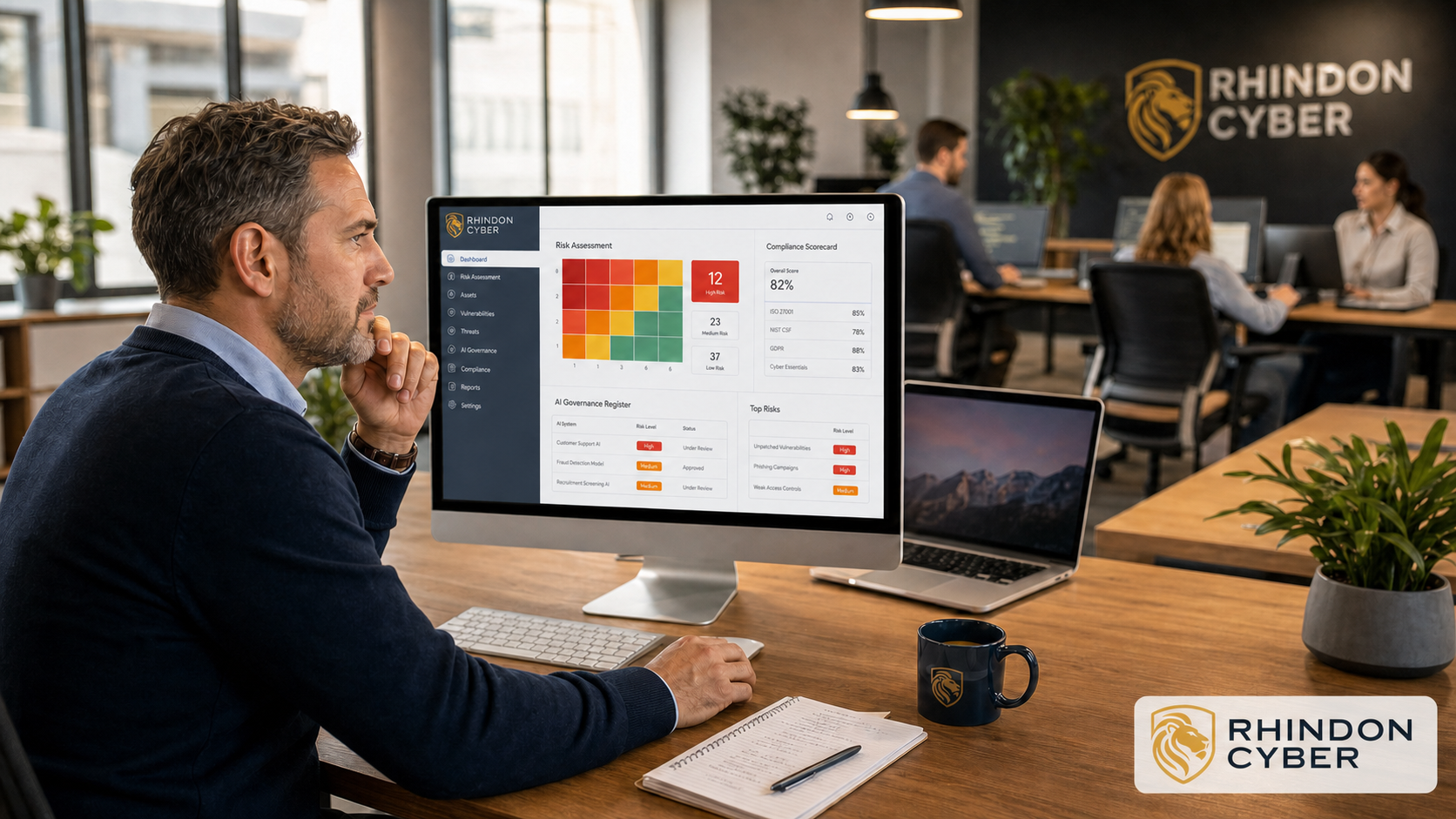
- AI Risk Register & Heatmap with automated Likelihood × Impact (L×I) Risk Scoring — providing a visual, calculated view of risk concentration without requiring manual matrix analysis
- Single-Stage Approval Workflow and AI Policy Library with Policy Attestation — establishing documented governance and a repeatable process for reviewing AI use
- AI Compliance Scorecard and Automated Gap Analysis — real-time visibility into control coverage gaps
- EU AI Act Classification and NIST AI RMF Integration — out-of-the-box alignment with the two most consequential AI governance frameworks
- Aslan AI Risk Assessment Template — an AI-generated assessment scaffold for use cases and system reviews
- Up to 6 user seats, app-based MFA, activity and audit logs, and guided onboarding tours
The Starter tier delivers precisely what the research literature recommends as a minimum viable governance program: documented assets, assessed risks, assigned controls, and monitored compliance. For an organization beginning at the Ad Hoc or Initial maturity level, Starter is the on-ramp — replacing the blank-page problem with structured registers, pre-built templates, and automated scoring.
Professional ($999/month): Growing Into Governance
As an SMB grows — adding employees, expanding AI use cases, entering regulated markets, or pursuing vendor certifications — the Professional tier unlocks the depth needed for a more mature risk program:
- Unlimited AI Use Case, Systems, and Controls registers
- Multi-Stage and Conditional Approval Workflows with Approval Delegation — distributing governance responsibility across departments
- Aslan AI Gap Analysis, Aslan AI Executive Summary, and Aslan AI Review Summary Generator — AI-generated analysis, board-ready reporting, and risk delta narratives between assessment cycles
- Aslan AI Incident Response Playbook — an eight-section, AI-generated incident response document with severity matrix and RACI matrix
- AI Attestation Scheduling Engine — automating the cadence of policy acknowledgment across the organization
- Aslan AI Control Description Writer — automatically drafting control language
- AI Regulatory Tracker — monitoring the evolving global regulatory landscape
- Up to 25 user seats
The Professional tier corresponds to the "Repeatable" to "Managed" stages of the RIMS Risk Maturity Model. Governance is no longer episodic — it is structured, delegated, documented, and measurable. The multi-stage approval workflows and attestation scheduling ensure that risk management becomes embedded in organizational operations rather than reactive to incidents.
Enterprise ($1,800/month): Institutional-Grade Governance
The Enterprise tier is designed for SMBs and growth-stage companies that require institutional-grade AI governance — whether driven by EU AI Act enforcement, ISO 42001 certification requirements, SOC 2 or HIPAA obligations, or supply chain compliance demands from larger partners:
- Aslan AI Incident Report Book — an aggregated enterprise incident report with coverage gap analysis across the full AI portfolio
- Up to 1,000 user seats — scaling governance across large organizations and multi-department structures
- REST API for Real-Time AI Telemetry Ingest — enabling integration with existing security infrastructure for continuous monitoring
- White-label and partner branding — supporting organizations delivering AI governance as a service to their own clients
- MSP Partner Program access — unlocking full white-label resale capabilities
At the Enterprise level, RAIC delivers the continuous monitoring and audit-ready documentation that NIST's 2025 AI RMF updates explicitly call for — moving organizations beyond policy toward active measurement, evidence collection, and improvement cycles.
What Makes RAIC Uniquely Suited to SMBs
Designed for Teams Without a Compliance Department
RAIC's foundational design principle — built for teams without a dedicated AI compliance department — directly addresses the literacy and talent barriers identified across the academic literature. The Aslan AI-generated templates, policy drafts, risk assessments, and executive summaries do not require users to have a background in GRC, information security, or AI governance. They provide the structure, vocabulary, and documentation that most SMBs lack but cannot afford to hire.
Framework Coverage on Day One
NIST AI RMF and ISO/IEC 42001 are the two dominant normative frameworks for AI governance worldwide. RAIC includes automated alignment scoring against both frameworks out of the box, as well as EU AI Act classification — meaning an SMB does not need to hire a framework consultant before beginning compliance demonstration. This is particularly significant given that ISO 42001 certification is moving from optional to RFP-mandatory in financial services, healthcare, and defense contracting.
Scalable Architecture That Eliminates Migration Costs
One of the most common and costly mistakes SMBs make in risk management is selecting a tool appropriate for their current size but not their future state — then facing a complete platform migration as they grow. RAIC's three-tier architecture eliminates this problem: all data, registers, policies, and controls persist as organizations upgrade from Starter to Professional to Enterprise. The governance work done in Starter does not need to be redone in Professional. Risk maturity compounds rather than restarting.
Connected Risk Registers with Cross-Record Linkages
Unlike spreadsheet-based approaches or siloed tools, RAIC maintains cross-record linkages — connecting AI policies to use cases, use cases to AI systems, systems to controls, and controls to risk scores. This connected architecture is what enables the AI Compliance Scorecard and automated gap analysis: when a control is updated, its effect on the overall risk posture is reflected immediately across all linked records. For SMBs operating with small teams, this connectivity replaces what would otherwise require a dedicated risk analyst to maintain manually.
MSP-Ready for Outsourced Delivery
RAIC is purpose-built to support MSP-delivered AI governance. The platform's white-label architecture allows MSPs to deploy RAIC under their own brand, delivering AI governance retainers to SMB clients at price points that are accessible to the client and profitable to the provider — without the MSP needing to build the underlying governance technology. This makes RAIC a natural infrastructure layer for MSPs building a vCAIO practice, enabling small businesses to access institutional-grade governance through their existing technology partner rather than hiring dedicated staff or purchasing multiple disconnected tools.
Pricing Aligned with SMB Economics
The academic literature is clear that cost is a primary barrier to risk program adoption in SMBs. RAIC's Starter tier at $349/month represents a fraction of the cost of traditional GRC platforms, which typically start at $24,500 per year before implementation and customization fees. At the Professional tier ($999/month), RAIC delivers capabilities that larger platforms reserve for enterprise contracts. The 14-day free trial at the Professional tier, with no credit card required, removes the evaluation risk entirely.
The Regulatory Backdrop: Why Waiting Is Not an Option
The compliance environment facing SMBs has materially shifted. The EU AI Act is now in active enforcement, with provider and deployer penalties reaching €35 million or 7% of global annual turnover. ISO/IEC 42001 certification is increasingly required in financial services, healthcare, and defense supply chain RFPs. In the United States, NIST's 2025 AI RMF update expands the framework to address generative AI, supply chain vulnerabilities, and new attack models — and emphasizes continuous monitoring as the operative standard rather than annual compliance checkpoints.
EisnerAmper's analysis of scaling AI systems (2026) observed that scaling AI without a structured risk framework exposes hidden governance gaps that become progressively harder to address, and that responsible AI adoption requires alignment across strategy, technology, people, and data. The organizations that build governance infrastructure early — when it is inexpensive and relatively simple to do — will face materially lower compliance costs and business disruption than those who begin under regulatory pressure.
From Starter to Enterprise: A Practical Growth Roadmap
For an SMB considering RAIC, the maturity journey maps practically across three phases aligned with the RIMS Risk Maturity Model:
Phase 1 — Starter: Establish Visibility and Baseline Controls Document AI use cases and systems already active in the organization. Assign basic controls. Run the automated gap analysis to identify the most critical exposures. Publish and attest to an AI acceptable use policy. This phase directly addresses the awareness deficit and moves the organization from Ad Hoc to Initial maturity.
Phase 2 — Professional: Build Repeatable Governance Processes Expand the AI registry to all business use cases. Implement staged approval workflows for new AI adoption. Use the Aslan AI Executive Summary to bring risk visibility to leadership. Run the AI Attestation Scheduling Engine to make policy acknowledgment a recurring process. Develop an incident response playbook before one is needed. This phase moves the organization from Initial to Repeatable/Managed maturity and prepares it for ISO 42001 alignment.
Phase 3 — Enterprise: Institutional Governance and Continuous Monitoring Integrate real-time AI telemetry via the REST API for continuous monitoring. Expand user seats across all departments. Use the AI Regulatory Tracker to stay ahead of evolving requirements. Produce the Aslan AI Incident Report Book for board-level oversight. Pursue ISO 42001 certification as a competitive differentiator in RFPs. This phase corresponds to the Integrated and Optimized levels of risk maturity.
References
Agarwal, P. K., & Arya, K. (2026). Shadow AI in the enterprise: Innovation with risk and compliance. American Journal of Technology, 5(5), 12–23. doi.org/10.58425/ajt.v5i5.537
Caldwell, M., et al. (2024). Cybersecurity preparedness of small-to-medium businesses. Computers & Security, 145. doi.org/10.1016/j.cose.2024.103316
ConnectWise. (2024). 2024 MSP threat report. ConnectWise Cyber Research Unit. connectwise.com/company/press/releases/2024-msp-threat-report-unveiling-key-findings-cybersecurity-threats-emerging-technologies
Diligent. (2024). The enterprise risk management maturity model explained. diligent.com/resources/blog/erm-maturity-model
EisnerAmper. (2026, March 23). Before you scale: A risk management framework for AI systems. eisneramper.com/insights/artificial-intelligence-insights/ai-risk-management-framework-for-scaling-0326
Guardz. (2025). 2025 SMB cybersecurity report. guardz.com
Microsoft. (2024). Small and medium business (SMB) cyberattacks are on the rise. Microsoft Security.
National Institute of Standards and Technology. (2023). Artificial intelligence risk management framework (AI RMF 1.0). U.S. Department of Commerce. doi.org/10.6028/NIST.AI.100-1
PinPoint Tech. (2026). Should you outsource IT or hire in-house? SMB cost-benefit guide. pinpointtech.pro/blog/outsource-it-vs-hire-in-house-cost-benefit-smb
Rhindon Cyber. (2026). RAIC platform pricing and feature comparison. raic.rhindoncyber.com/pricing
RIMS. (2006). RIMS risk maturity model (RMM) for enterprise risk management. Risk and Insurance Management Society. riskmaturitymodel.org
Riskonnect. (2022). How to use a risk maturity model to level up. riskonnect.com/enterprise-risk-management/how-use-risk-maturity-model
Saha, B., & Anwar, Z. (2024). A review of cybersecurity challenges in small business: The imperative for a future governance framework. Journal of Information Security, 15, 24–39. doi.org/10.4236/jis.2024.151003
Sage & IDC. (2026). SMB cybersecurity in the AI era: Research findings. Sage Group / International Data Corporation.
Schellman. (2026, January 19). Responsible AI governance and ISO 42001 explained. schellman.com/blog/iso-certifications/iso-42001-and-responsible-ai-governance
Sophos. (2024). Addressing the cybersecurity skills shortage in SMBs. sophos.com/en-us/blog/addressing-the-cybersecurity-skills-shortage-in-smbs
Sentrient. (2025, May 1). How to build a risk assessment framework: 5 essential steps. sentrient.com.au/blog/how-to-build-risk-assessment-framework
University of Wisconsin Continuing Professional Education. (2025). Enterprise risk management for small businesses: What it is and how to start. blog.uwcped.org/enterprise-risk-management-for-small-businesses-what-it-is-and-how-to-start
Vitharana, P., & Dharwadkar, R. (2007). Information systems outsourcing: Linking transaction cost and institutional theories. Communications of the Association for Information Systems, 20. doi.org/10.17705/1CAIS.02023
Wharton Human-AI Leadership Initiative. (2023). Artificial intelligence risk & governance. University of Pennsylvania. ai.wharton.upenn.edu/white-paper/artificial-intelligence-risk-governance
FAQ
What is a comprehensive risk assessment for an SMB?
A comprehensive risk assessment is a systematic process for identifying, analyzing, evaluating, and treating risks across an organization's operations, data, and technology — including AI systems. For SMBs, it should cover cyber threats, AI governance gaps, policy compliance, and regulatory alignment in a structure that is repeatable and documented.[^30][^5]
Why do SMBs need a formal risk assessment program?
Peer-reviewed research consistently shows that SMBs face the same threat landscape as large enterprises but with far fewer resources to respond. Over 60% of SMBs that suffer a significant cyberattack shut down within six months (Saha & Anwar, 2024). A formal risk assessment program moves security from reactive guesswork to proactive, documented risk management — enabling resource-constrained organizations to prioritize the controls that matter most.[^1]
What AI governance frameworks should an SMB follow?
The two primary frameworks are the NIST AI Risk Management Framework (AI RMF 1.0), a voluntary cross-sector framework organized around Govern, Map, Measure, and Manage functions, and ISO/IEC 42001, the first international AI Management System standard. RAIC includes automated compliance scoring against both frameworks at all tiers.[^12][^13][^11][^4]
Why should an SMB work with an MSP for AI governance rather than hiring in-house?
The economics are compelling. A mid-level compliance or IT professional costs $88,000–$120,000 per year fully loaded — and covers a single role with limited specialization. An MSP delivering AI governance as a managed service provides multi-disciplinary expertise, continuous coverage, and certified tooling at $500–$2,500 per month, typically 18–22% lower total cost of ownership over five years compared to equivalent in-house programs. Empirical research also shows that SMBs working with MSPs experience lower breach impact than those managing security independently.[^14][^26][^16]
What is shadow AI, and why does it matter for risk assessment?
Shadow AI refers to AI tools and services used by employees without IT approval or governance controls. Agarwal and Arya (2026) identify shadow AI as a primary driver of governance drift and audit failure in SMB environments. Industry data shows that shadow AI use can increase data breach costs by approximately 15%, and that the majority of employees in typical SMB environments are using unsanctioned AI tools. A comprehensive risk assessment program must include AI system discovery and use case governance to address this exposure.[^20][^21][^19]
How often should an SMB conduct a comprehensive risk assessment?
Best practice guidance recommends a full risk assessment at minimum every 12 to 18 months, with interim assessments triggered by significant changes such as new AI tool adoption, system migrations, or regulatory developments. RAIC's continuous governance model — with automated gap analysis, compliance scorecards, and attestation scheduling — supports ongoing rather than episodic risk management.[^8][^4]
Bring AI governance into one platform
Start a free trial of RAIC and operationalize the practices in this article.
Start trial