
Shadow AI: What It Is, Why It Costs $670,000 More Per Breach, and How SMBs Can Govern It (2026)
By David Mosher, CEO, Rhindon Cyber | AI Governance & Compliance Expert | Former Microsoft, Bridgewater Associates, Raytheon
Quick Answer: Shadow AI refers to AI tools and applications that employees use within an organization without IT approval, security review, or governance oversight (Agarwal & Arya, 2026). It is the AI-era evolution of shadow IT, and in 2026 it affects the majority of organizations worldwide.
Organizations with high levels of shadow AI experienced an average of $670,000 in additional data breach costs compared to organizations with low or no shadow AI (IBM Security, 2025). This makes it one of the most quantifiable, and most preventable, financial risks in enterprise security. For SMBs, where a single breach can be existential, governing shadow AI is not optional. This guide explains what shadow AI is, why employees use it, and what the research shows about its risks. It also explains exactly how to build a governance program that addresses it.
Table of Contents
- What Is Shadow AI?
- Why Shadow AI Is Different From Shadow IT
- The Scale of the Problem: What the Data Shows in 2026
- The Academic Evidence: Why Employees Use Shadow AI
- The Four Risk Categories of Shadow AI
- The $670,000 Question: How Shadow AI Increases Breach Costs
- Shadow AI and Regulatory Compliance
- The Governance Matrix: Four Responses and Their Trade-offs
- A Seven-Step Shadow AI Governance Program for SMBs
- How RAIC Detects and Governs Shadow AI
- References
What Is Shadow AI?
Shadow AI is the use of AI tools, assistants, large language models (LLMs), browser extensions, or personal AI accounts inside an organization. This usage occurs without formal approval, visibility, or governance from IT, security, legal, or compliance teams (Agarwal & Arya, 2026). It is the AI-specific manifestation of a broader organizational pattern: employees adopting technology that makes their work easier without waiting for formal approval processes. This pattern is now amplified by the unique characteristics of consumer-grade generative AI.
The tools involved are typically consumer-grade LLM interfaces accessible directly through a browser: ChatGPT personal accounts, Claude, Gemini, Perplexity, Grammarly AI, Notion AI, and dozens of productivity-enhancing AI applications embedded in widely used SaaS platforms. What distinguishes shadow AI from authorized AI is not the tool itself, as many of these tools exist in enterprise-licensed versions. The key distinction is the absence of organizational visibility, policy review, risk assessment, and governance documentation.
For SMBs specifically, shadow AI is the rule, not the exception. Industry surveys consistently find that 55–78% of employees use AI tools not sanctioned by their employer. As few as 16% of employees use employer-authorized AI tools exclusively (Gillespie et al., 2025).
Companies with as few as 11 to 50 employees average 269 unsanctioned AI tool installations per 1,000 employees. This means roughly 27% of all employees at a small firm are actively using AI outside IT's awareness (UpGuard, 2025). The governance gap at the SMB level is proportionally larger than at enterprises. This is because SMBs typically lack the security operations resources to detect what they cannot see.
Why Shadow AI Is Different From Shadow IT
Shadow IT — the use of unauthorized software, hardware, or cloud services — has been an enterprise risk management concern for decades. Shadow AI inherits all of shadow IT's risks and adds several that are qualitatively new.
Unique Technological Affordances
Waters-Lynch, Allen, Potts, and Berg (2025), publishing in Innovation: Organization and Management (Q1, Taylor & Francis), formally define the phenomenon as shadow user innovation (SUI). This is covert, employee-driven value creation enabled by readily concealable digital tools. It is undertaken when private productivity or learning benefits outweigh the expected organizational rewards of disclosure. Their framework identifies four technological affordances that make consumer-grade generative AI uniquely concealable compared to traditional shadow IT:
- Individual adoptability: Browser-based AI services require no installation, no IT credentials, and no procurement approval — leaving no asset scan footprint.
- Low or zero marginal cost: Freemium and consumer-tier pricing allows employees to experiment without triggering financial approval processes.
- Minimal technical footprint: No local installation means no software asset management detection, no endpoint visibility, and no network traffic patterns typical of installed applications.
- Natural-language malleability: LLM interfaces accept plain language — meaning any employee, regardless of technical skill, can embed AI into their workflow. A single knowledge worker can now build a prompt chain, script an automated process, or develop a retrieval system over a lunch break without writing a single line of traditional code.
These affordances mean that the organizational detection mechanisms designed for shadow IT — software asset management, endpoint detection, procurement monitoring — are largely ineffective against browser-based generative AI. An employee pasting proprietary data into ChatGPT leaves no more detectable a trace than browsing a website.
New Risk Constructs
Sebastian (2026), building on this in Technological Forecasting and Social Change (Elsevier, IF 12.9), introduces the Digital Shadow AI Risk Theoretical Framework (DART). The framework identifies six distinct risk constructs created by this combination of accessibility and invisibility:
- Unintentional Disclosure Risk
- Trust-Dependence Paradox
- Data Sovereignty Conflict
- Knowledge Dilution Phenomenon
- Ethical Black Box Problem
- Organizational Feedback Loops
Each construct represents a category of harm that organizations may not realize is occurring — often for months or years after exposure has begun.
The Scale of the Problem: What the Data Shows in 2026
The empirical picture of shadow AI in 2026 is unambiguous in its scale:
- 55–78% of employees use AI tools not sanctioned by their employer; Salesforce (2024) found 55% while Microsoft WorkLab (2025) found 78% bring their own AI to work
- 59% of employees use shadow AI at work; only 16% use exclusively employer-authorized tools (Gillespie et al., 2025)
- 50% of employees use unauthorized AI tools; of these, 46% would continue using them even if explicitly banned by their organization (Software AG, 2024, as cited in ISC2 Community, 2025)
- 20% of organizations experienced a data breach caused by shadow AI usage in 2025 — one in five breaches began with unsanctioned AI tools introducing vulnerabilities (IBM Security, 2025)
- $670,000 in additional breach costs for organizations with high shadow AI levels versus those with low or no shadow AI (IBM Security, 2025)
- 3.2x more AI tools in active use than appear in organizational AI system registries — for every governed AI tool, there are 3.2 unregistered tools in active employee use (COMPEL Framework, 2026)
- 57% of employees submit sensitive information to AI tools; 86% of organizations cannot see these data flows (MintMCP, 2025)
For SMBs, the significance of these numbers is magnified by resource constraints. An enterprise absorbs a $670,000 breach cost premium as a painful but survivable financial event. For many SMBs — particularly in professional services, healthcare, financial services, and legal — a breach of this magnitude can trigger client notification obligations, regulatory penalties, litigation, and reputational damage. Collectively, these far exceed the direct financial cost.
The Academic Evidence: Why Employees Use Shadow AI
Understanding why employees use shadow AI — not just that they do — is the foundation of an effective governance response. Two bodies of peer-reviewed research converge on a consistent explanation.
The Shadow User Innovation Framework (Waters-Lynch et al., 2025)
Waters-Lynch, Allen, Potts, and Berg (2025) model shadow AI adoption as a rational economic decision driven by three interacting variables: work-process lead-userness (WPLU), technological concealability, and organizational trust climate.
Work-process lead-userness is the degree to which an employee encounters work-process bottlenecks ahead of peers and perceives high personal benefit from resolving them. Employees high in WPLU are the first to feel workflow friction — slow report generation, repetitive summarization tasks, research bottlenecks — and the most motivated to solve it. When a freely available tool solves the problem in minutes, the barrier to adoption is functionally zero.
Technological concealability is the degree to which a tool can be used without organizational detection. Consumer-grade generative AI scores near-maximum on this dimension: browser-based, no installation, zero-cost entry, natural language interface. The result is that the costs of covert adoption are negligible while the productivity benefits are immediately realized.
Organizational trust climate determines whether employees disclose their use. Waters-Lynch et al. (2025) formalize this as a revelation threshold. Employees disclose shadow innovations when the perceived productivity gain (ΔP) multiplied by organizational trust (T) exceeds the expected sanction (S). Formally, this is expressed as ΔP × T > S. In low-trust environments, or in organizations where AI tool discovery is followed by punitive responses, this threshold is rarely crossed.
Valuable, productive shadow innovations remain invisible — creating what the authors call a dynamic-capability blind spot: the organization cannot learn from, scale, or govern what it cannot see.
The governance implication is direct: punitive responses to shadow AI (blocking, surveillance, disciplinary action) lower trust. This suppresses the revelation threshold, which means innovations stay hidden. The governance approaches that surface hidden AI use — and thereby enable risk management — are those that raise trust and lower perceived sanctions while providing sanctioned alternatives.
Conflicting Impacts on Knowledge Leakage (Chin et al., 2025)
Chin, Wang, Yang, Duan, and Chen (2025) published in Technology in Society (Elsevier, Vol. 81). They examine the dual-sided nature of shadow AI's organizational impact using a Yin-Yang paradox framework. Their central finding is that the relationship between shadow AI usage and organizational knowledge leakage (OKL) is non-linear. There is an inverted U-shaped relationship. Moderate levels of shadow AI usage are associated with productivity benefits, while high levels are associated with significant knowledge leakage risks.
The practical implication for SMB governance is twofold. First, zero-tolerance policies that drive shadow AI fully underground may paradoxically increase knowledge leakage risk. These policies eliminate the partial visibility that allows organizations to identify and remediate the highest-risk tool usages. Second, the governance goal is not elimination but management — establishing visibility, assessing risk, and channeling unsanctioned usage toward governed alternatives. Organizations that achieve this middle state realize productivity benefits while containing knowledge leakage through documented governance controls.
The DART Framework (Sebastian, 2026)
Sebastian's (2026) Digital Shadow AI Risk Theoretical Framework (DART) was published in Technological Forecasting and Social Change (Vol. 229, Article 124697). It provides the most comprehensive taxonomy of shadow AI organizational risk. The six DART constructs are:
- Unintentional Disclosure Risk: Employees share confidential, proprietary, or regulated data with external AI platforms. They do so without understanding that input data may be used for model training, stored in vendor systems, or accessible to third parties.
- Trust-Dependence Paradox: The more an employee trusts an AI tool's outputs, the more sensitive the data they share with it. This creates an escalating disclosure risk that tracks with perceived tool quality rather than actual security posture.
- Data Sovereignty Conflict: Data entered into consumer AI tools may be processed in jurisdictions with different privacy laws than the organization's regulatory obligations (GDPR, HIPAA, CCPA/CPRA). This creates cross-border data transfer compliance exposure without organizational awareness.
- Knowledge Dilution Phenomenon: Repeated reliance on AI-generated outputs without organizational review creates epistemic risk. Decisions are then informed by AI outputs that embed hallucinations, biases, or outdated information without any human validation checkpoint.
- Ethical Black Box Problem: Shadow AI tools operate outside the organization's explainability and audit frameworks. When an AI-informed decision is challenged — legally, ethically, or operationally — the organization cannot reconstruct the reasoning chain or demonstrate appropriate oversight.
- Organizational Feedback Loops: Shadow AI use becomes self-reinforcing. As more employees adopt unsanctioned tools, social proof normalizes the behavior, escalating aggregate exposure faster than governance programs can respond.
The Four Risk Categories of Shadow AI
Synthesizing the academic evidence with operational security research, shadow AI risk for SMBs clusters into four categories, each with distinct governance priorities.
1. Data Exposure and Privacy Risk
When an employee pastes a client contract, financial projection, patient record, or source code into a consumer AI tool, that data leaves the organizational boundary. The receiving platform's terms of service — not the organization's data governance policy — governs how that data is stored, processed, and potentially used for model training. In regulated industries (healthcare, financial services, legal, government contracting), this creates direct HIPAA, GDPR, CCPA, and sector-specific compliance exposure.
IBM Security's (2025) finding that 20% of organizations experienced breaches caused by shadow AI reflects this exposure pathway. This pathway involves data shared with an unvetted tool, processed in an uncontrolled environment, and subsequently involved in a security incident. The organization has no visibility into this incident until after the breach occurred.
2. Regulatory and Compliance Risk
The EU AI Act (European Parliament & Council of the European Union, 2024) imposes documentation obligations on organizations that deploy AI in contexts affecting EU residents. These include Article 4 AI literacy requirements, Article 26 human oversight obligations, and Article 50 transparency requirements.
An organization cannot comply with Article 26's human oversight requirements for AI systems it does not know exist.
Shadow AI similarly undermines compliance for several key frameworks:
- SOC 2 Type II compliance by creating data flows outside the audited control environment.
- HIPAA compliance by exposing PHI to unvetted vendors.
- ISO 27001 compliance by introducing third-party risk outside the formal supplier assessment process.
In each case, the compliance exposure exists regardless of whether the organization intended to create it. Intent is not a defense in regulatory proceedings.
3. IP and Confidentiality Risk
Many consumer AI platforms retain user inputs according to their terms of service to:
- improve their models,
- serve targeted content, or
- share data with third-party partners.
When employees input proprietary product specifications, M&A strategy, client engagement details, or personnel information into these tools, the organization may be transferring intellectual property to external systems. This transfer occurs without contractual protection.
Agarwal and Arya (2026) document this in their American Journal of Technology review as one of the most material compliance risks of shadow AI. This is particularly true for organizations in competitive industries where IP protection is a core business asset.
Unlike a data breach, IP leakage through shadow AI is often silent:
- no breach notification occurs,
- no incident is detected, and
- the competitive harm may not manifest until months or years after the exposure.
4. Operational and Decision-Quality Risk
The Knowledge Dilution Phenomenon identified by Sebastian (2026) and the Ethical Black Box Problem are operational risks. These risks do not require a security incident to cause organizational harm. When employees rely on AI-generated outputs — market analyses, compliance assessments, technical recommendations, financial projections — without validation against organizational knowledge or documented AI governance processes, decision quality degrades. This degradation occurs in ways that are difficult to detect and difficult to attribute.
For SMBs where individual employees often have outsized influence on consequential decisions, AI-generated hallucinations or biases embedded in shadow tool outputs can propagate through the organization. These can influence outcomes — product launches, client advice, regulatory filings, hiring decisions — with significant downstream consequences.
The $670,000 Question: How Shadow AI Increases Breach Costs
IBM Security's (2025) Cost of a Data Breach Report — which surveys 604 organizations across 17 industries and 16 countries — provides the most comprehensive quantification of shadow AI's breach cost premium. The specific findings are:
- 20% of organizations in the study experienced a breach caused by shadow AI usage
- Organizations with high levels of shadow AI paid an average of $670,000 more per breach than organizations with low or no shadow AI — $4.63 million versus $3.96 million
- The breach cost premium directly reflects the additional investigation, remediation, and notification costs that arise when an organization cannot reconstruct what data was exposed, to which systems it flowed, and through which pathways
The $670,000 figure is not primarily the cost of the breach itself — it is the cost of not knowing. When a breach occurs involving shadow AI tools, the organization lacks several key assets that would allow rapid scoping, containment, and notification:
- audit logs,
- data flow documentation,
- vendor risk assessments, and
- usage records.
The result is longer mean time to identify (MTTI), longer mean time to contain (MTTC), and broader notification obligations. All of these factors increase cost.
IBM Security's (2025) data also shows the inverse. Organizations using security AI and automation saved an average of $1.9 million per breach and shortened their breach lifecycle by 80 days. The implication is symmetric and actionable: governance visibility reduces cost. Shadow AI governance is therefore not a compliance expenditure — it is breach cost reduction with a calculable ROI.
Shadow AI and Regulatory Compliance
Shadow AI creates specific compliance exposure across every major framework that SMBs are likely to encounter.
| Regulation / Framework | Shadow AI Compliance Risk | Specific Obligations Undermined |
|---|---|---|
| EU AI Act | Deployer obligations apply to AI systems regardless of how they were adopted | Article 4 (AI literacy), Article 26 (human oversight documentation), Article 50 (transparency) |
| GDPR | Consumer AI tools process EU personal data outside the DPIA process | Article 25 (data protection by design), Article 28 (processor agreements), Article 35 (DPIA) |
| HIPAA | PHI input into consumer AI tools reaches unvetted Business Associates | §164.308 (administrative safeguards), §164.312 (technical safeguards), BAA requirement |
| SOC 2 Type II | Data flows outside audited control environment undermine TSC criteria | CC6.1 (logical access), CC7.2 (system monitoring), P3.2 (privacy collection) |
| CMMC Level 2/3 | CUI processed in consumer AI tools violates data handling requirements | AC.L2-3.1.3 (CUI flow control), SI.L2-3.14.7 (identify unauthorized AI use) |
| ISO/IEC 42001 | Shadow AI tools are outside AIMS scope by definition — cannot be governed if not inventoried | Clause 6 (risk assessment), Clause 8 (operation control), Annex A.4 (AI lifecycle) |
The pattern across all frameworks is consistent: regulatory compliance requires organizational knowledge of the AI systems in operation. Shadow AI, by definition, exists outside that organizational knowledge. This means compliance with any AI-relevant regulation is structurally impossible for AI systems that governance programs cannot see.
The Governance Matrix: Four Responses and Their Trade-offs
Waters-Lynch et al.'s (2025) shadow user innovation governance matrix provides the most research-grounded framework for organizational response. Crossing risk tolerance with learning orientation produces four archetypes, each with distinct dynamic-capability effects.
| Archetype | Risk Tolerance | Learning Orientation | Effect on Shadow AI | SMB Suitability |
|---|---|---|---|---|
| Repressive | Low | Reactive | Blocks tools, increases sanctions, drives AI underground — reduces visibility without reducing risk | Not recommended — creates compliance illusion |
| Permissive | High | Reactive | Acknowledges use without governance — some surface-level visibility, minimal risk reduction | Not recommended — liability increases |
| Integrative | Low | Proactive | Sandboxed experimentation, approved alternatives, AI champions — raises disclosure threshold | Best for regulated SMBs (healthcare, financial, legal) |
| Structural | High | Proactive | AI embedded in workflow governance, centers of excellence, continuous discovery — full dynamic-capability engagement | Best for technology-forward SMBs with mature risk posture |
The research-supported conclusion is that repressive governance does not eliminate shadow AI. Instead, it eliminates organizational visibility of shadow AI while leaving the underlying risk unchanged (Waters-Lynch et al., 2025). Employees who encounter an AI block find workarounds: personal devices, home networks, off-hours usage. The data still flows; the organization simply cannot see it.
The most effective responses for SMBs are integrative and structural. These approaches:
- provide sanctioned alternatives that meet the productivity need driving shadow adoption,
- establish lightweight approval pathways for new AI tools, and
- create a transparency culture where employees feel safe surfacing AI use rather than concealing it.
The revelation threshold equation (ΔP × T > S) makes the operational implication explicit — raise trust, reduce the perceived cost of disclosure, and innovations surface where they can be governed.
A Seven-Step Shadow AI Governance Program for SMBs
The following program is calibrated for SMBs building shadow AI governance from a low baseline — the most common starting point. Each step addresses a specific gap in organizational visibility, policy, or control.
Step 1: Discovery — Find What You Cannot See
The first step is technical discovery: identifying AI tools in use across the organization regardless of whether they appear in any approved list or procurement record.
Discovery methods:
- Browser extension agent that surfaces AI tool usage across employee browsers — the most comprehensive method, capturing browser-based generative AI that bypasses all network-layer controls
- SaaS usage analytics from identity providers (Azure AD, Okta) identifying OAuth token grants to AI applications
- DNS and proxy log analysis for requests to known AI platform domains (openai.com, anthropic.com, gemini.google.com, claude.ai, etc.)
- Employee survey — a structured disclosure mechanism that invites self-reporting without punitive framing. It often surfaces tools that technical discovery misses.
Output: A preliminary AI system inventory — the raw material for all subsequent governance steps. Per NIST AI RMF (NIST, 2023), the Map function cannot begin without this inventory.
Step 2: Classify — Assess Risk by Tool and Context
Not all shadow AI carries equal risk. A browser-based grammar checker poses different organizational risk than an LLM that employees are using to draft client communications, generate financial analysis, or review legal documents. Classification focuses governance resources on the highest-risk exposures.
Risk classification dimensions:
- Data sensitivity: Does the tool typically receive confidential, regulated, or proprietary data?
- Vendor security posture: Does the vendor have a published privacy policy, data retention policy, security certifications, and an enterprise tier with data governance provisions?
- Regulatory exposure: Does the use case involve PHI, PII, CUI, financial data, or EU personal data?
- Decision consequence: Does the tool output inform consequential decisions without human validation?
- Usage volume: High-frequency use amplifies both productivity value and exposure risk
Output: A risk-tiered AI tool registry — high, medium, and low risk designations for each tool, with documented rationale.
Step 3: Policy — Establish an AI Acceptable Use Policy
The AI Acceptable Use Policy (AUP) is the governance foundation that defines what employees may and may not do with AI tools, what data classification levels may be submitted to which tool categories, and the consequences of policy violation. An effective AUP is brief, specific, and practical — not a prohibitive document but a governance reference that employees consult when deciding how to use AI.
Core AUP elements:
- Approved AI tool list (with links to approved enterprise versions where available)
- Data handling rules by classification. This defines what data may never be submitted to consumer AI tools (PII, PHI, CUI, trade secrets, client data) and what data may be submitted to approved tools with appropriate safeguards.
- New tool approval process: a lightweight pathway for employees to request evaluation of tools not yet on the approved list. Faster is better, as slow approval processes are the primary driver of shadow adoption.
- Incident reporting: how to report accidental data submission to an unapproved tool
- Consequences: clear but proportionate — emphasis on remediation and transparency, not punitive responses that suppress the revelation threshold
Output: Published AI AUP, signed by leadership, communicated across the organization, integrated into onboarding.
Step 4: Train — Build AI Literacy That Changes Behavior
AI literacy training is mandated by EU AI Act Article 4 for organizations subject to its scope — and is best practice regardless of regulatory exposure. Effective AI literacy training for shadow AI governance is not generic AI education. It is specific to the tools employees use, the risks those tools create in the organization's specific context, and the policies that govern their use.
Training design principles:
- Role-specific content: The risks for a finance employee using AI to summarize financial projections differ from those for a developer using AI-assisted code generation or an HR team using AI screening tools
- Concrete examples: Specific scenarios relevant to the organization — what would it look like to accidentally submit client data to ChatGPT? What are the consequences?
- AUP integration: Training is the vehicle for AUP communication — employees should exit training knowing exactly what they can and cannot do
- Completion documentation: Training records satisfy Clause 7 of ISO 42001 and demonstrate EU AI Act Article 4 compliance
Output: Documented AI literacy training program with completion records by role.
Step 5: Control — Implement Technical Safeguards
Policy without technical controls depends entirely on voluntary compliance. Technical controls enforce governance at the system level, reducing dependence on employee memory of policy requirements.
Priority technical controls for SMBs:
- DLP rules targeting AI platform domains — prevent submission of data classified as confidential or higher to consumer AI tools through corporate network paths
- CASB or browser proxy rules that flag or block access to unapproved AI tools on managed devices
- Browser extension governance — approved browser extensions list that prevents installation of unapproved AI-enabled extensions
- OAuth scope restriction — limit AI application OAuth grants through the identity provider to prevent broad data access permissions
- Shadow AI detection tooling — automated discovery that continuously identifies new AI tool adoption and alerts the governance team to unapproved tools entering the environment
Output: Technical controls documented in the security control register with evidence of operation.
Step 6: Monitor — Continuous Discovery and Incident Response
Shadow AI governance is not a one-time project. New AI tools launch continuously, employee adoption patterns evolve, and risk assessments expire as vendor terms of service, security postures, and regulatory interpretations change.
Effective governance requires a continuous monitoring cadence.
Monitoring program elements:
- Monthly AI tool discovery scan — identify new tools entering the environment since the last scan
- Quarterly AUP review — update approved tool list, data handling rules, and risk classifications as the AI tool landscape evolves
- AI incident response procedure — a documented process for responding to suspected shadow AI data exposure events. This includes:
- scope identification,
- vendor notification,
- regulatory reporting assessment, and
- remediation.
- Employee disclosure mechanism — a low-friction channel for employees to self-report shadow AI use or suspected data exposure without fear of punitive response
Output: Ongoing AI tool registry with change log; documented incident response procedure; monitoring logs satisfying Clause 9 of ISO 42001.
Step 7: Integrate — Embed Shadow AI Governance in Existing Frameworks
Shadow AI governance does not exist in isolation — it must integrate with existing organizational risk management, compliance, and security programs to be sustainable.
Integration touchpoints:
- ISO 42001 AIMS: Shadow AI discovery produces the AI system registry that is the operational core of the AIMS. The monitoring cadence satisfies Clause 9 performance evaluation requirements.
- NIST AI RMF: Discovery and classification address the Map function. Risk assessment addresses Measure. Policy and controls address Manage. Leadership commitment and AUP address Govern.
- ISO 27001 ISMS: Shadow AI tools are third-party applications — vendor risk assessment integrates into the supplier relationship management process; DLP controls align with information security control A.5.14
- Vendor Risk Management: Every approved AI tool requires a vendor security assessment before addition to the approved list. This involves reviewing the privacy policy, data retention terms, security certifications, and contractual data governance provisions.
Output: Integrated governance documentation; shadow AI governance section in the existing risk register; vendor assessment records for approved AI tools.
How RAIC Detects and Governs Shadow AI
RAIC (AI Risk & Integrity Cloud) by Rhindon Cyber is purpose-built to address the discovery and governance gap that makes shadow AI the defining organizational risk of 2026 for SMBs.
Browser Extension Agent: Discovery Without Blind Spots
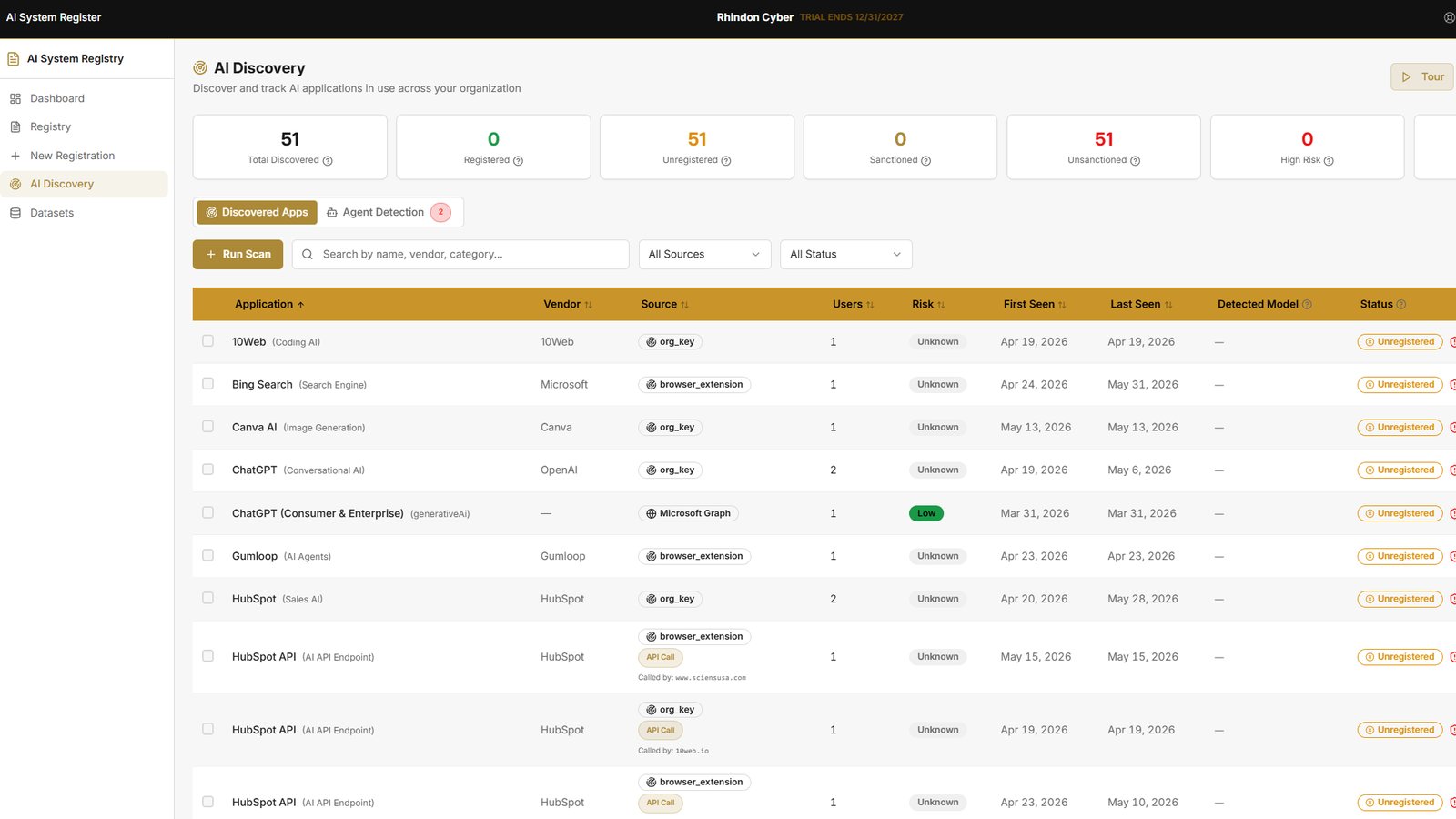
RAIC's browser extension agent continuously surfaces AI tool usage across employee browsers. This is the only detection method that captures browser-based generative AI that bypasses network-layer, DNS, and proxy-based controls. The extension populates the AI System Registry in real time as employees use AI tools, producing a continuously updated inventory that reflects actual organizational AI usage rather than a static approved list.
The discovery output directly addresses the core gap documented by Sebastian (2026): most organizations have no systematic way to know what AI systems are in operation. RAIC's registry closes this visibility gap — turning the unknown unknown of shadow AI into a known, governable inventory.
Risk Classification and Governance Workflows
RAIC applies automated risk classification to discovered tools based on vendor security posture, data handling practices, regulatory certification status, and usage context. This produces a risk-tiered registry that focuses governance attention on the highest-risk exposures rather than treating every tool uniformly.
For each discovered tool, RAIC generates a governance action: approve with safeguards, escalate for security review, or flag for policy enforcement. This workflow supports the integrative governance approach recommended by Waters-Lynch et al. (2025) — providing a structured pathway for surfacing and evaluating shadow AI rather than simply blocking it.
Compliance Reporting: NIST AI RMF, ISO 42001, EU AI Act
RAIC generates compliance reports mapped simultaneously to NIST AI RMF Map function requirements, ISO 42001 Clause 6 and Annex A.4 controls, and EU AI Act Article 26 deployer documentation obligations. This enables a single shadow AI governance program to satisfy all three stakeholder frameworks.
For SMBs subject to multiple regulatory requirements — a common profile in healthcare, financial services, and government contracting — RAIC's unified reporting eliminates the need to maintain separate governance evidence packages for each framework.
Request a RAIC Shadow AI Discovery Assessment at raic.rhindoncyber.com. Receive a complete inventory of AI tools in use across your organization — including tools your IT team doesn't know exist.
References
Agarwal, P. K., & Arya, K. (2026). Shadow AI in the enterprise: Innovation with risk and compliance. American Journal of Technology, 5(5), 12–23. doi.org/10.58425/ajt.v5i5.537
Chin, T., Wang, W., Yang, M., Duan, Y., & Chen, Y. (2025). Conflicting impacts of shadow AI usage on knowledge leakage in metaverse-based business models: A Yin-Yang paradox framing. Technology in Society, 81, Article 102687. doi.org/10.1016/j.techsoc.2024.102687
European Parliament & Council of the European Union. (2024, July 12). Regulation (EU) 2024/1689 laying down harmonised rules on artificial intelligence (Artificial Intelligence Act). Official Journal of the European Union. eur-lex.europa.eu/eli/reg/2024/1689/oj
Gillespie, N., Lockey, S., Curtis, C., Pool, J., & Akbari, A. (2025). Trust in artificial intelligence: A global study 2024 [Dataset]. University of Melbourne & KPMG Australia. doi.org/10.26188/28822919
IBM Security. (2025). Cost of a data breach report 2025. IBM Corporation. ibm.com/reports/data-breach
ISC2 Community. (2025, May 14). Shadow AI on the rise: 50% of employees using unapproved AI tools. ISC2. community.isc2.org/t5/Industry-News/Shadow-AI-on-the-Rise-50-of-Employees-Using-Unapproved-AI-Tools/td-p/79019
National Institute of Standards and Technology. (2023, January 26). Artificial intelligence risk management framework (AI RMF 1.0) (NIST AI 100-1). U.S. Department of Commerce. doi.org/10.6028/NIST.AI.100-1
Sebastian, G. (2026). Digital shadow AI risk theory (DART): A framework for managing data disclosure and privacy risks of AI tools at work. Technological Forecasting and Social Change, 229, Article 124697. doi.org/10.1016/j.techfore.2026.124697
Software AG. (2024). AI at work: How employees and business leaders view the use of AI in the workplace [Survey, n=6,000 knowledge workers across U.S., UK, and Germany]. Software AG.
UpGuard. (2025). The state of shadow AI: Enterprise risk from unsanctioned AI tools [Survey, n=1,500 security leaders and employees]. UpGuard. upguard.com/reports/state-of-shadow-ai
Waters-Lynch, J., Allen, D. W. E., Potts, J., & Berg, C. (2025). Shadow user innovation: Governing covert generative-AI use for dynamic-capability renewal. Innovation: Organization and Management. Advance online publication. doi.org/10.1080/14479338.2025.2519546
This article was written by David Mosher, CEO of Rhindon Cyber and publisher of the Pragmatic Cybersecurity newsletter. Rhindon Cyber builds AI governance and risk management tools for SMBs and managed service providers. RAIC is available at raic.rhindoncyber.com.
FAQ
What is shadow AI?
Shadow AI refers to AI tools, assistants, large language models, browser extensions, or personal AI accounts used within an organization without IT approval, security review, or governance documentation (Agarwal & Arya, 2026). It is the AI-era evolution of shadow IT, distinguished by browser-based accessibility, zero installation footprint, and natural-language interfaces that make it uniquely difficult to detect with traditional security controls.
How common is shadow AI?
Industry surveys consistently find that 55–78% of employees use AI tools not sanctioned by their employer (Salesforce, 2024; Microsoft WorkLab, 2025). As few as 16% of employees use exclusively employer-authorized AI tools (Gillespie et al., 2025). For organizations with fewer than 50 employees, average shadow AI usage runs approximately 27% of all employees — meaning roughly one in four staff members at a small firm is actively using unapproved AI tools (UpGuard, 2025).
Why do employees use shadow AI?
Waters-Lynch et al. (2025) explain shadow AI adoption as a rational economic decision: employees with high work-process lead-userness encounter bottlenecks, find freely available tools that solve the problem immediately, and adopt them because the productivity benefit is immediate and the concealment cost is near zero. The decision to disclose or conceal use depends on organizational trust climate — employees in high-trust environments with low perceived sanctions are far more likely to surface their AI use.
What does shadow AI cost an organization?
IBM Security's (2025) Cost of a Data Breach Report found that organizations with high levels of shadow AI experienced an average of $670,000 in additional breach costs — $4.63 million compared to $3.96 million for organizations with low or no shadow AI. This premium reflects the investigation, remediation, and notification costs that arise when organizations lack audit logs, data flow documentation, and vendor risk assessments for tools involved in a breach.
What regulations does shadow AI violate?
Shadow AI creates compliance exposure across most major frameworks: EU AI Act (Article 4 AI literacy, Article 26 human oversight, Article 50 transparency), GDPR (Article 25 data protection by design, Article 28 processor agreements), HIPAA (§164.308 administrative safeguards, Business Associate Agreement requirements), SOC 2 Type II (logical access, system monitoring, privacy criteria), CMMC (CUI flow control, unauthorized AI identification), and ISO 42001 (Clause 6 risk assessment, Annex A.4 AI system lifecycle). The common thread: compliance with AI-relevant regulations requires organizational knowledge of the AI systems in operation — which shadow AI, by definition, eliminates.
Is banning shadow AI the right governance approach?
No. Waters-Lynch et al. (2025) demonstrate that repressive governance — blocking tools and increasing sanctions — does not eliminate shadow AI; it eliminates organizational visibility of shadow AI. Employees find workarounds on personal devices and off-network access. Risk persists; visibility disappears. The governance approaches that actually reduce risk are those that raise organizational trust, provide sanctioned alternatives, and create low-friction disclosure pathways — making it easier for employees to use governed AI than to maintain shadow usage.
What is the first step in governing shadow AI?
Discovery. An organization cannot govern what it cannot see. The first governance step is a technical discovery scan — ideally using a browser extension agent that surfaces all AI tool usage regardless of installation footprint — to establish an accurate picture of the AI tools in active use. This inventory is the foundation of every subsequent governance action: risk classification, policy development, training, technical controls, and compliance reporting.
How does shadow AI relate to ISO 42001?
ISO 42001's Clause 6 requires risk assessment and AI system impact assessment for all AI systems within the AIMS scope. Shadow AI tools are outside AIMS scope by definition — they cannot be assessed, controlled, or documented if they are not in the organizational inventory. ISO 42001 implementation without shadow AI discovery produces an incomplete AIMS that will fail Stage 2 certification audit review of operational effectiveness. Shadow AI governance is a prerequisite for credible ISO 42001 compliance.
How does RAIC address shadow AI?
RAIC's browser extension agent continuously discovers AI tools in use across the organization — including browser-based generative AI that bypasses network-layer and endpoint-based detection. The RAIC AI System Registry receives real-time tool discovery data, producing a continuously updated inventory. RAIC then applies automated risk classification, generates governance workflows (approve, review, flag), and produces compliance reports mapped to NIST AI RMF, ISO 42001, and EU AI Act simultaneously. Request a Shadow AI Discovery Assessment at [raic.rhindoncyber.com](https://raic.rhindoncyber.com).
What data does shadow AI most commonly expose?
Based on the risk categories identified in Sebastian's (2026) DART framework, the most commonly exposed data categories in shadow AI incidents are: client data and communications (relationship information, contracts, engagement details), proprietary business information (product plans, financial projections, M&A strategy), employee and HR data (performance reviews, compensation, candidate information), and regulated data including PHI (healthcare information) and PII subject to GDPR and CCPA/CPRA obligations. Each category carries distinct regulatory notification and remediation obligations that a shadow AI breach makes difficult to scope accurately.
Bring AI governance into one platform
Start a free trial of RAIC and operationalize the practices in this article.
Start trial